

The system uses a building’s own signal reflections as a computational resource, adapting in real time without prior knowledge of the environment.
MIDDLETOWN, Conn. — A physicist at Wesleyan University has demonstrated a wireless signal control system that optimizes itself in real time without measuring, mapping, or simulating the room it operates in, according to a paper published December 13, 2025 in Nature Communications.
The system uses a programmable panel called a reconfigurable intelligent surface (RIS) to adjust how electromagnetic waves reflect around an indoor environment. Instead of treating the complex reflections inside a building as a problem to be modeled and overcome, the design uses those reflections as a computational resource, allowing the environment itself to perform the physics required to optimize signal delivery.
“There is an ideal computer that solves these types of complex problems exactly,” said Tsampikos Kottos, the Wesleyan physicist who led the research. “What is this computer? The environment itself.”
The Problem With Indoor Wireless
Radio signals inside buildings rarely travel in straight lines. They bounce off walls, reflect from metal furniture, scatter around door frames, and interfere with one another in patterns that constantly change when anything in the environment moves.
Traditional wireless engineering deals with this complexity by carefully modeling the geometry of the room, measuring signal strength at many points, simulating reflections with software, and recalibrating whenever the environment changes.

The process is expensive, time-consuming, and fragile. It becomes even harder with 5G and emerging 6G systems, where millimeter-wave frequencies are so sensitive that a human body can block a signal entirely.
Kottos and his team have spent years developing a different approach. Their system, known as in-situ physical adjoint computing, treats the complexity of indoor environments as an advantage rather than a problem.
How the System Works
At the center of the system is a reconfigurable intelligent surface, a programmable panel made up of many small elements. Each element can be adjusted to change how it reflects electromagnetic waves.
Instead of mapping the room and calculating optimal settings ahead of time, the system learns through iteration.
It sends a signal toward a target, measures the result, slightly adjusts the surface, and measures again.
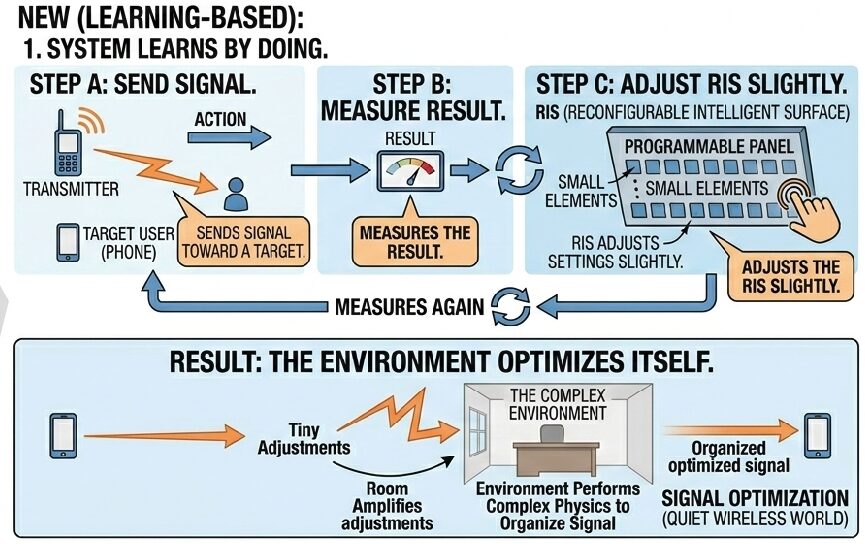
Because indoor environments amplify even small adjustments into large changes in reflection patterns, each cycle gives the system enough information to improve the signal configuration. Over time, the system converges on an optimal solution — without ever needing to know the room’s layout.
In experiments, the team demonstrated three capabilities using this method:
Targeted signal delivery
The system focused an electromagnetic wave on a specific point in a cluttered room without prior knowledge of the environment.
Coherent perfect absorption
Signals could be completely absorbed at a chosen location instead of scattering, which could enable secure communication or wireless power transfer.
Electromagnetic camouflage
The system could make a target effectively invisible to sensors in a highly reflective environment.
Why It Matters for Future Wireless Networks
Reconfigurable intelligent surfaces are widely considered essential infrastructure for 6G networks, expected to emerge in the early 2030s.
These networks are projected to require extremely high indoor data rates, ultra-low latency, and precise wireless control for robotics, factories, and industrial automation.
Current RIS systems require extensive calibration for each environment. If the room changes, the surface must be reprogrammed.
A system based on adjoint optimization removes that barrier. It requires no prior calibration, continuously adapts as the environment changes, and keeps improving as it operates.
That could significantly simplify large-scale deployment of programmable wireless environments.
Source
Guillamon, J., Wang, C.-Z., Lin, Z., & Kottos, T. (2025). In-situ physical adjoint computing in multiple-scattering electromagnetic environments for wave control. Nature Communications, Vol. 16, Article 11466. DOI: 10.1038/s41467-025-66385-5.

Ray Jackson holds a BSc in Electrical Engineering from the University of Manitoba and a PhD in Physics from Carleton University. His reporting interests include Current and Future Technologies, Engineering and Artificial Intelligence.