
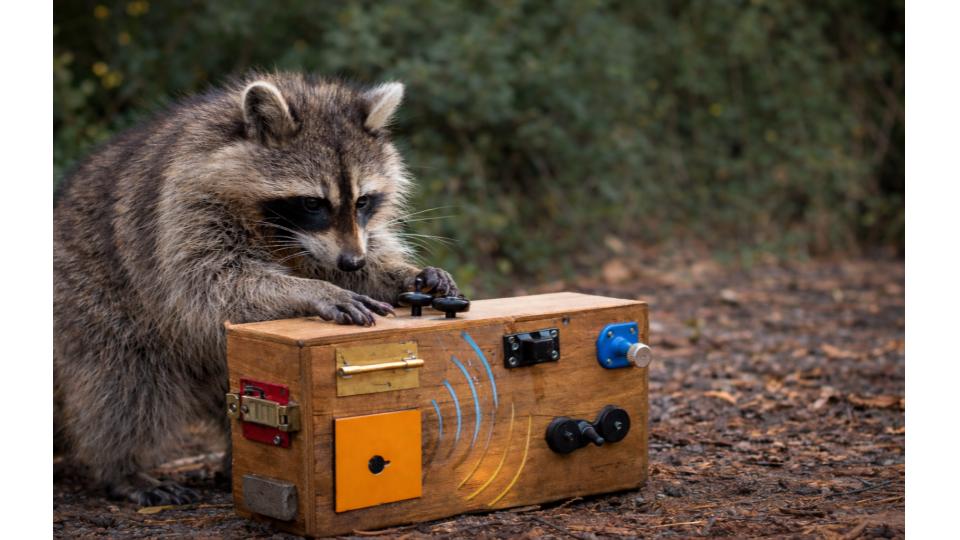
Raccoons Keep Solving Puzzles Even After the Food Is Gone
That is the conclusion of a new study from the University of British Columbia, which found that raccoons continue solving puzzles long after any food reward is gone. The behaviour, which researchers describe as “information foraging,” suggests that curiosity itself drives the animals, not just hunger.
The findings were published March 9 in the journal Animal Behaviour.
A Box With Nine Ways In
Researchers Hannah Griebling and Dr. Sarah Benson-Amram used a custom multi-access puzzle box with nine entry points, grouped as easy, medium, and hard. The mechanisms included latches, sliding doors, and knobs. Each 20-minute trial included a single marshmallow as the reward.
The raccoons retrieved the food and then kept going.
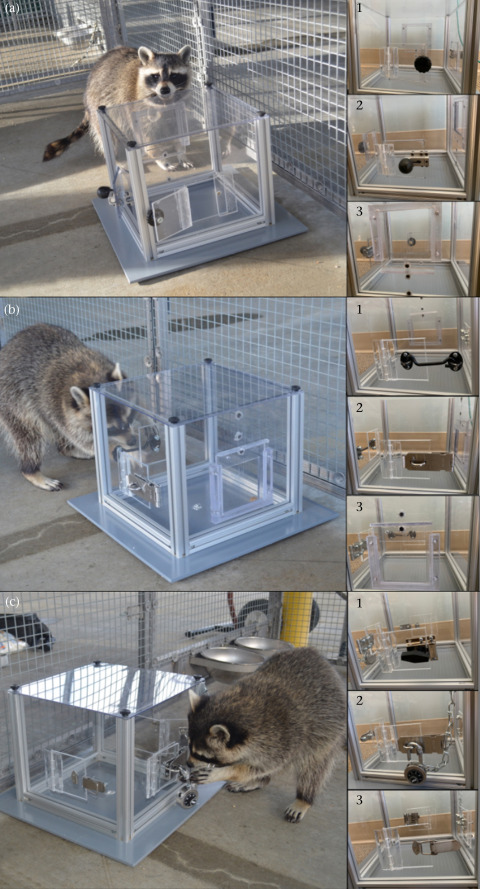
“We weren’t expecting them to open all three solutions in a single trial,” said Griebling. “They kept problem solving even when there was no marshmallow at the end.”
This continued problem-solving, with no additional food on offer, is what the researchers classified as information foraging. The raccoons were not hungry. They were curious.
Playing It Safe When the Stakes Are Higher
The study also revealed something more nuanced about how raccoons make decisions under uncertainty.
When solutions were easy, raccoons explored broadly, trying multiple openings and varying their order. As task difficulty increased, they favored a dependable solution, but still explored multiple solutions even at the hardest level.
Griebling said this mirrors a very familiar human experience. “Do you order your favourite dish or try something new? If the risk is high, an expensive meal you might not like, you choose the safe option. Raccoons explore when the cost is low and quickly decide to play it safe when the stakes are higher.”
This kind of risk-adjusted behaviour is known in decision-making theory as the exploration-exploitation trade-off. Animals and humans alike must balance the value of trying something new against the safety of sticking with what works. The raccoons in this study calibrated that trade-off dynamically, adjusting their strategy based on how difficult and therefore how risky a given puzzle was.
Built for Urban Life
The findings shed new light on why raccoons have become so successful in cities. It is not just that they are bold or opportunistic. They appear to have a genuine drive to gather information about their environment, and the physical tools to act on it.
Their forepaws, rich with sensory nerves originally suited to foraging in streams, are well suited to manipulating latches and handles, often the same kinds used by humans.
That combination of cognitive flexibility and physical dexterity gives raccoons a significant edge in urban settings, where novel challenges appear constantly and the ability to adapt quickly matters.
“Raccoon intelligence has long featured in folklore, yet scientific research on their cognition remains limited. Studies like this provide empirical evidence to support that reputation,” said Dr. Benson-Amram.
Practical Implications
The research was conducted with captive raccoons at a facility in Colorado. The authors caution that wild raccoons may not behave identically, though prior studies suggest the gap is small.
“Understanding the cognitive traits that help raccoons thrive can guide management of species that struggle, and inform strategies for other species, like bears, that use problem-solving to access human-made resources,” said Griebling.
As cities expand and encounters between humans and wildlife become more frequent, understanding what drives animal problem-solving may help managers develop better strategies, not just to deter animals, but to anticipate how they adapt over time.
For now, the study makes one thing clear. The raccoon rifling through your compost bin is not just looking for dinner. It may simply want to know what is in there.
References
- Griebling, H.J., Johnson, S.R., & Benson-Amram, S. (2026). Raccoons optimally forage for information: exploration–exploitation trade-offs in innovation. Animal Behaviour. https://doi.org/10.1016/j.anbehav.2026.123491
- UBC News. (2026, March 9). Raccoons solve puzzles for the fun of it, new study finds. https://news.ubc.ca/2026/03/raccoons-solve-puzzles-for-the-fun-of-it-new-study-finds/

Jane holds a BSc in Biology from the University of Regina and a Master of Science in Bioscience, Technology and Public Policy from the Univesity of Winnipeg. Her reporting interests include Life Sciences, Physical Sciences and the Cosmos.