
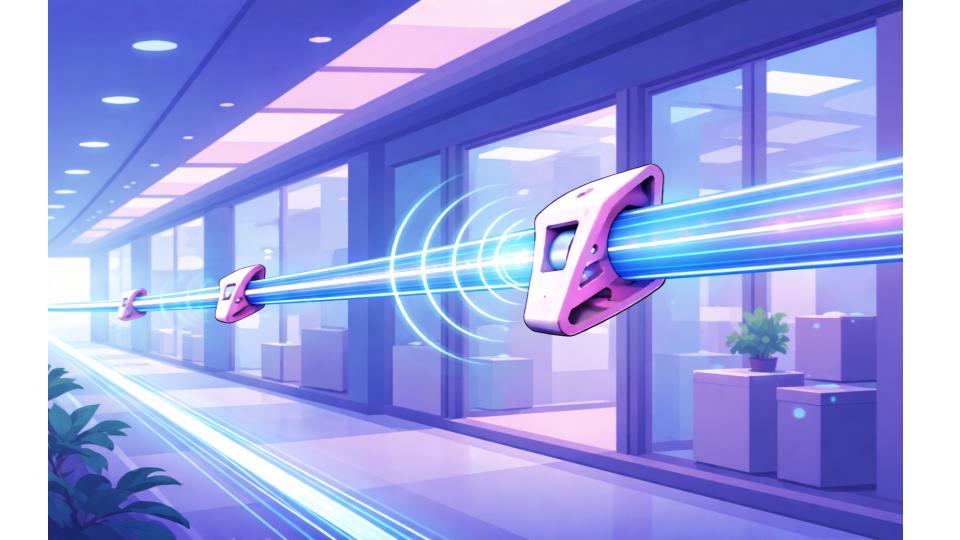
Small clips placed along a cable create antennas exactly where coverage is needed, allowing base stations to transmit at close range rather than broadcasting across an entire room.
SINGAPORE — A new analysis of pinching antenna technology shows the approach can dramatically reduce interference and energy consumption in multi-cell wireless networks, according to a paper published February 22, 2026 by a researcher at Nanyang Technological University.
Pinching antennas, first demonstrated by NTT DOCOMO in 2022, work by attaching small dielectric clips to a plastic cable carrying a radio frequency signal. Each clip causes radio energy to leak from the cable at that exact point, creating a functional antenna. Moving the clip moves the antenna. Adding a clip adds an antenna. Removing it eliminates the antenna entirely.
The February paper, authored by Zhiguo Ding at NTU, examined what happens when pinching antennas are deployed across multiple cells simultaneously, as they would be in real-world networks. It found that because antennas can be positioned centimeters from the user, base stations can transmit at very low power rather than broadcasting at high power across a large area.
“A quiet wireless world,” is how Ding described the result in the paper, referring to the near-elimination of signal interference between neighboring cells when every transmission is proximity-based and low power.
How the technology works
A dielectric waveguide, a specialized plastic cable, carries a radio frequency signal along its length, mostly contained inside the cable material. Attaching a small dielectric clip at any point along the cable disturbs the guided wave just enough to cause radio energy to leak out at that location. That leakage point functions as the antenna.
The cable can run along a ceiling, wall, hallway, or factory floor. Coverage is created wherever a clip is placed and eliminated when the clip is removed. The system installs similarly to running Ethernet cable, without antenna mounts, RF site surveys, or complex infrastructure planning.
NTT DOCOMO’s original prototype operated in the 28 GHz millimeter wave band, the spectrum designated for high-speed 5G and 6G indoor deployments. Early tests confirmed the underlying physics performed as predicted.
The interference problem it addresses
Conventional wireless infrastructure broadcasts signals in all directions from a fixed point. Users near the edge of a coverage zone receive weak signals, requiring the base station to increase transmission power to maintain the connection.
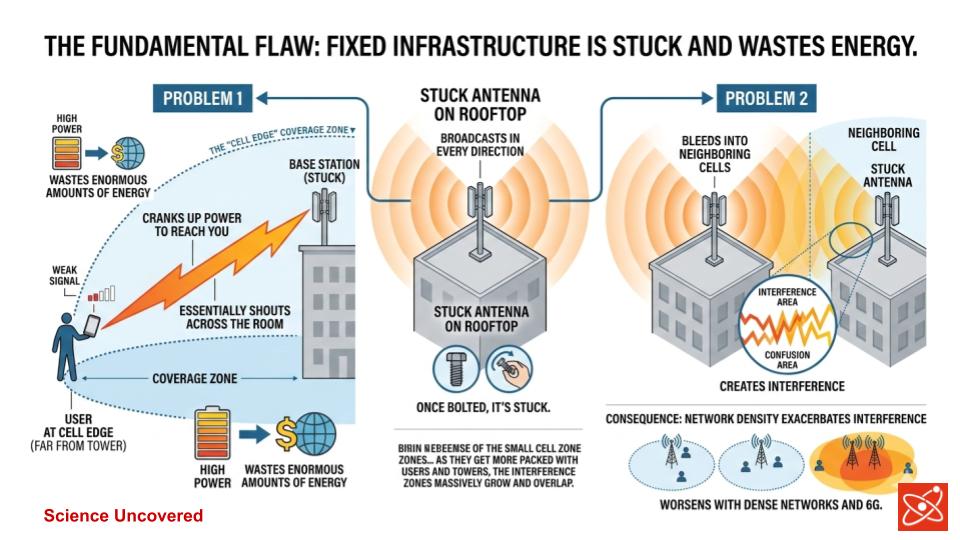
That high-power omnidirectional broadcasting bleeds into neighboring cells and generates interference, a problem that worsens as network density increases.
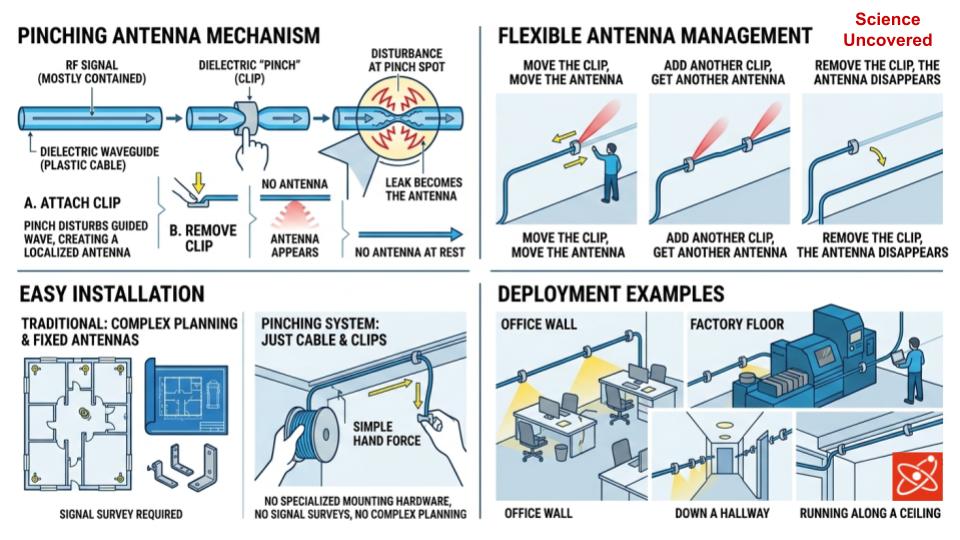
Because pinching antennas position the transmission point close to the user, the required power drops sharply. Signal bleed into neighboring cells becomes negligible. Ding’s analysis found the approach does not produce incremental efficiency gains but represents a structural change in how interference propagates through a network.
Development and target applications
Since the original 2022 NTT DOCOMO demonstration, researchers have published studies on beamforming for pinching systems, security implications, radar sensing integration, AI-controlled clip placement, and applications in trains, tunnels, factories, and satellite systems. The technology has developed almost entirely within academic literature and has not yet reached commercial deployment.
The approach is particularly suited to environments where fixed wireless infrastructure struggles, including hospital corridors, factory floors, subway tunnels, parking structures, and office buildings undergoing renovation. In each case, coverage requirements change frequently and dead zones created by fixed access points are difficult and costly to address.
For 6G specifically, where millimeter wave signals carry high data rates but penetrate walls poorly and lose strength quickly over distance, keeping the signal inside a cable until it reaches the point of use minimizes losses and eliminates the need for high-power transmission to compensate for distance.
Current status
The physics of pinching antennas is considered established within the wireless engineering research community. The outstanding question is scaling, moving from laboratory demonstrations to deployed networks in real buildings. No commercial deployment timeline has been announced by NTT DOCOMO or other network operators.
Sources
Ding, Z. (2026). Toward a Quiet Wireless World: Multi-Cell Pinching-Antenna Transmission. arXiv:2602.19459.
Fukuda, A., et al. (2022). Pinching antenna — using a dielectric waveguide as an antenna. NTT DOCOMO Technical Journal, Vol. 23, No. 3.

Ray Jackson holds a BSc in Electrical Engineering from the University of Manitoba and a PhD in Physics from Carleton University. His reporting interests include Current and Future Technologies, Engineering and Artificial Intelligence.