
Centuries-old Japanese craftsmanship has unexpectedly revealed one of the most exotic materials in modern physics — and scientists have just reached a major milestone in understanding it.
Physicists studying a class of metals whose atomic structure is based on a centuries-old Japanese weaving pattern have reached a significant milestone, with a landmark review published February 12, 2026 in Reviews of Modern Physics signaling the field has matured into one of the most active areas of condensed matter physics.
A second study, published February 19, 2026, showed that squeezing one of these materials under high pressure caused its superconducting properties to strengthen and become more controllable. That finding matters because it suggests these materials can be tuned for real-world use, a critical step toward practical applications in energy transmission and electronics.
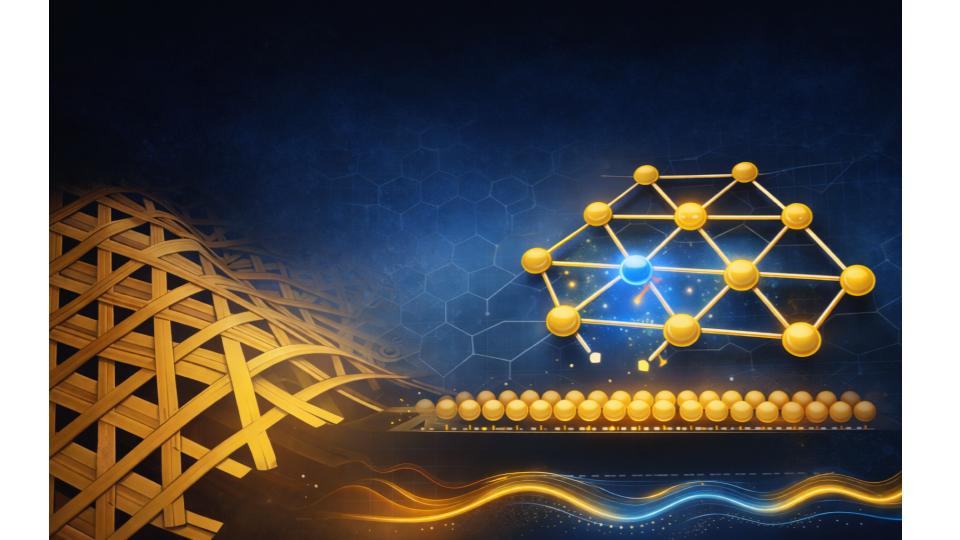
The materials are called kagome metals. Kagome is a Japanese word referring to an interlocking pattern of triangles and hexagons traditionally woven into bamboo baskets. When atoms inside a metal are arranged in that same geometry, something unexpected happens. The electrons stop behaving like electrons in ordinary metals and start doing things that physicists are still struggling to fully explain.
Why the geometry matters
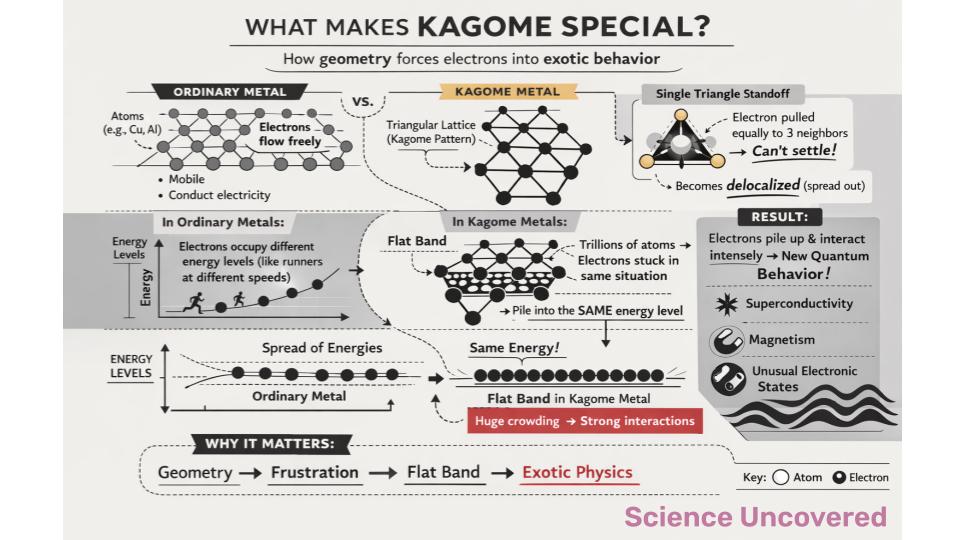
In a normal metal like copper, electrons flow freely between atoms in well-understood ways. The arrangement of atoms in the background.
In kagome metals, the geometry takes over.
The triangular arrangement puts electrons in an impossible position. Each electron tries to settle into its lowest energy state, but the geometry pulls it equally toward multiple neighboring atoms at once. It cannot fully commit to any of them.
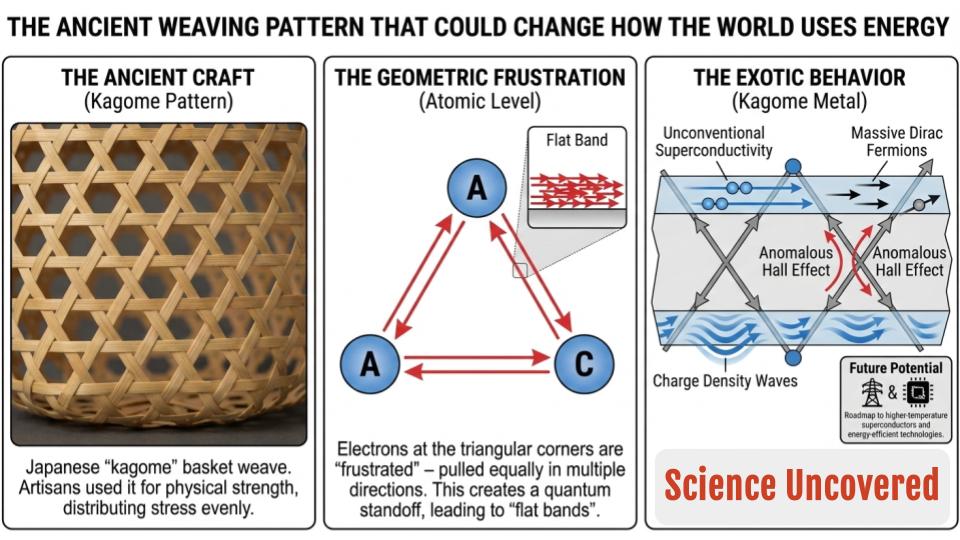
Physicists call this geometric frustration, and across billions of atoms in a crystal it produces something remarkable: huge numbers of electrons end up sharing the same energy level, packed into what researchers call flat bands.
When electrons are forced together like that, their interactions become extraordinarily strong. And strong interactions between electrons are where strange physics begins.
What these materials actually do
The February review catalogues a range of phenomena that kagome metals produce, several of which should not be able to coexist according to older theories.
Some kagome metals become superconducting, carrying electrical current with zero resistance and zero energy loss, but through a mechanism that does not fit the standard explanation of how superconductivity works. In certain conditions, electrons inside these materials start behaving like the exotic relativistic particles described by Einstein-era physics equations, while simultaneously acquiring properties they are not supposed to have.
Some kagome metals deflect electrical currents sideways without any external magnetic field acting on them, an effect generated entirely by the geometry of the atomic lattice. And in some cases, electrons spontaneously rearrange themselves into repeating wave patterns of high and low density, a phenomenon that in older physics was considered incompatible with superconductivity. In kagome metals, both happen at once.
None of these effects is minor on its own. Seeing all of them arise from the same underlying geometry is what has made the field so compelling to physicists.
The pressure experiment
The second study, conducted by researchers from Europe and Japan, took a kagome superconductor called LaRu3Si2 and squeezed it to about 6,000 times atmospheric pressure. That sounds extreme but is relatively modest by the standards of materials physics.
The results were significant. Under pressure, the temperature at which the material became superconducting increased, and its magnetic response strengthened sharply. More importantly, both effects changed in predictable, controllable ways as pressure was applied.
That controllability is what the field has been working toward. A material that produces exotic quantum behavior but cannot be adjusted or engineered is scientifically interesting but practically useless. Demonstrating that kagome properties can be dialed up or down is a necessary step toward building something with them.
Why any of this matters outside a physics lab
Superconductivity is one of those phenomena that sounds almost too good to be true. A superconducting wire carries electricity with no resistance whatsoever, meaning no energy is lost as heat along the way. Power could theoretically be transmitted across continents without the losses that currently make long-distance electricity transmission inefficient. Superconducting components already sit at the heart of MRI machines, particle accelerators, and quantum computers.
The catch is temperature. Most superconductors only work near absolute zero, requiring expensive and cumbersome cooling infrastructure that makes them impractical outside specialized settings.
Kagome metals do not yet superconduct at room temperature. But they are giving physicists the clearest window yet into a form of superconductivity that does not follow the standard rules, and understanding those mechanisms is considered essential groundwork for eventually designing materials that work at practical temperatures.
The Reviews of Modern Physics publication is a marker of how far the field has come. Kagome metals were once an obscure curiosity. They are now a research frontier, with physicists deliberately engineering their geometry to probe specific properties rather than simply cataloguing surprising results.
The ancient basket weavers had no idea what they were onto.
The review “Kagome Metals” appeared in Reviews of Modern Physics on February 12, 2026 (Vol. 98, 015002). The pressure-tuning study of LaRu₃Si₂ was published the week of February 19, 2026, by a multinational collaboration including the Czech Academy of Sciences, the Max Planck Institute, and the University of Tokyo.
References
1. Di Sante, D., Neupert, T., Sangiovanni, G., Thomale, R., Comin, R., Checkelsky, J. G., Zeljkovic, I., & Wilson, S. D. (2026). Kagome metals. *Reviews of Modern Physics*, 98, 015002.
2. Král, P., Sazgari, V., Ge, Y., et al. (2026). Uniaxial stress tuning of superconductivity and magnetoresistance in the kagome superconductor LaRu₃Si₂. Published February 19, 2026. [Multinational collaboration: Czech Academy of Sciences, Max Planck Institute for Chemical Physics of Solids, University of Tokyo, Helmholtz-Zentrum Dresden-Rossendorf, London Centre for Nanotechnology, Vilnius University, Zhejiang University.] As reported by Quantum Zeitgeist: https://quantumzeitgeist.com/stress-boosts-superconductivity-material/
3. Khasanov, R., & Luetkens, H. (2023). Unconventional charge order and superconductivity in kagome-lattice systems as seen by muon-spin rotation. *npj Quantum Materials*, 8, 41.
4. Li, Z., et al. Electron-phonon coupling and superconductivity in the kagome metal CsV₃Sb₅. *Physical Review Letters*. USC Viterbi School of Engineering.
5. Ortiz, B. R., et al. (2020). New kagome prototype materials: Discovery of KV₃Sb₅, RbV₃Sb₅, and CsV₃Sb₅. *Physical Review Materials*, 3, 094407. [Discovery paper for the AV₃Sb₅ family referenced in the article.]
6. American Physical Society. (2026). *Reviews of Modern Physics*, Vol. 98, Issue 1 (January–March 2026). https://journals.aps.org/rmp/issues/98/1

Ray Jackson holds a BSc in Electrical Engineering from the University of Manitoba and a PhD in Physics from Carleton University. His reporting interests include Current and Future Technologies, Engineering and Artificial Intelligence.