
From telephone to ChatGPT: The incredible acceleration of how humans embrace new technology
It took the telephone 100 years to reach 1 billion users. ChatGPT did it in two.
That single fact reveals something profound about the moment we’re living through—not just about artificial intelligence, but about how radically technology adoption has accelerated across human history. What once took generations now happens in the span between New Year’s resolutions.
It took the telephone nearly 100 years to reach 1 billion users. ChatGPT did it in about 2 years.
This isn’t just an AI story, it’s a story about runaway acceleration in technology adoption. Each generation of technology builds the infrastructure that lets the next spread faster, until software like generative AI can reach global scale almost instantly.
We’re now in an era where transformative technologies spread faster than society, regulation, and institutions can adapt, compressing decades of change into just a few years.
The Fastest Adoption in Human History
When ChatGPT launched in November 2022, few predicted it would become the fastest-growing consumer technology in history. Within two months, it had reached 100 million users—a milestone that took Instagram nearly three years and Facebook over four years to achieve. By late 2024, combining ChatGPT with other generative AI platforms like Google Gemini, Microsoft Copilot, and Claude, the technology had reached an estimated 700 million to 1 billion users worldwide.
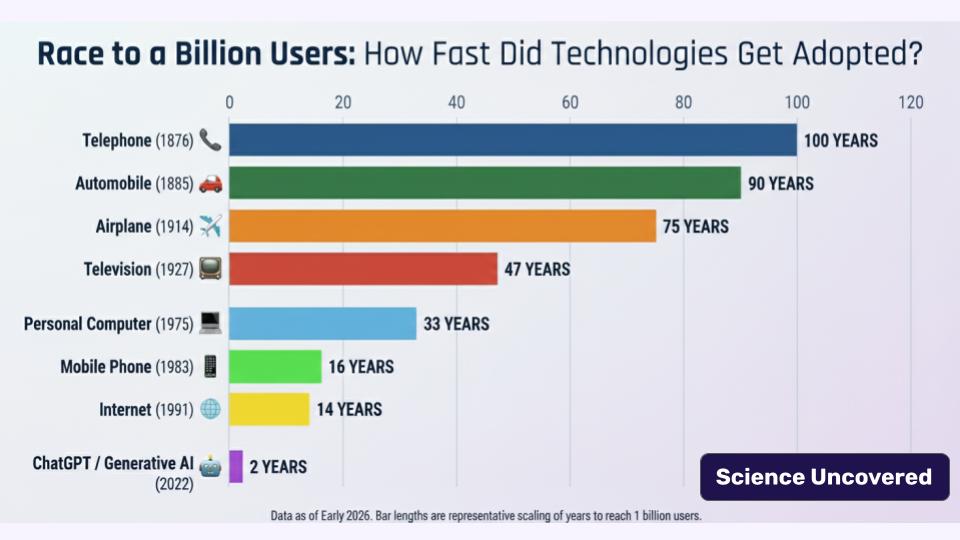
To put this in perspective: the telephone, invented in 1876, required approximately a century to reach 1 billion users globally. Television needed 47 years. The mobile phone, which seemed revolutionary in its adoption speed, took 16 years. Even TikTok, the previous record-holder for fastest consumer tech adoption, needed 5 years to hit the billion-user mark.
ChatGPT did it in 24 months, or potentially less, depending on how you count.
Why the Acceleration?
The exponential speedup in technology adoption isn’t random. Each successive wave of innovation builds infrastructure that accelerates the next:
Physical Infrastructure is Already Built: Unlike the telephone (which required installing millions of miles of copper wire) or electricity (power plants and distribution grids), AI launched into a world where 5 billion people already carried internet-connected supercomputers in their pockets. There was nothing to manufacture, ship, or install.
Zero Marginal Cost Distribution: Adding the millionth user costs essentially the same as adding the ten-millionth. Software scales in ways that physical products never could. Thomas Edison had to build power plants; Sam Altman just needed servers.
Network Effects on Steroids: Social media proved that viral growth was possible, but AI took it further. Every ChatGPT conversation screenshot shared on Twitter became free marketing. Every student using it for homework told ten friends. Every programmer using it to debug code told their entire team.
No Learning Curve Required: You don’t need to learn how to use ChatGPT, you just talk to it. Compare this to learning to drive a car, operate a computer, or even navigate Facebook’s interface. The barrier to entry approached zero.
Multilingual from Day One: Unlike previous technologies that spread country by country, ChatGPT launched with support for dozens of languages simultaneously. Someone in Tokyo could adopt it as quickly as someone in Toronto.
Free Tier Strategy: While iPhones cost $599 and required monthly service fees, ChatGPT offered a powerful free tier. Billions of people could try it without spending a cent.
The Adoption Curve Tells a Story
Looking at our visualization, you can see the acceleration of human adoption patterns:
The Industrial Era (1876-1950s): Technologies took 50-100 years to reach global scale. Adoption was limited by manufacturing capacity, distribution networks, and the need for supporting infrastructure. The telephone, automobile, and airplane all follow similar slow-growth curves.
The Electronic Era (1950s-1980s): Television and credit cards cut adoption time to 40-50 years. Mass manufacturing improved, but physical distribution still created friction.
The Digital Era (1990s-2000s): PCs, mobile phones, and the internet reached 1 billion users in 15-30 years. Digital distribution began reducing barriers, but hardware limitations remained.
The Social Media Era (2000s-2010s): Facebook, Instagram, and YouTube hit 1 billion in 8-9 years. Pure software platforms leveraging existing internet infrastructure achieved unprecedented growth.
The Platform Era (2010s-2020s): WhatsApp, WeChat, and TikTok reached 1 billion in 5-8 years. Mobile-first design and sophisticated virality mechanics accelerated adoption.
The AI Era (2020s): Generative AI platforms reached 1 billion in approximately 2 years—2.5 times faster than TikTok, the previous record holder.
What Makes AI Different?
While the speed is impressive, what’s perhaps more significant is what people adopted. Previous technologies changed how we communicate (telephone, internet) or how we entertain ourselves (television, social media). AI is changing how we think, create, and work.
Consider the breadth of use cases that emerged almost immediately:
- Students use it to understand complex topics and get homework help
- Programmers use it to debug code and learn new languages
- Writers use it to overcome writer’s block and brainstorm ideas
- Researchers use it to summarize papers and explore concepts
- Businesses use it for customer service, content creation, and analysis
- Creatives use it to generate images, music, and video
- Language learners use it as a patient tutor available 24/7
No previous technology served this many different purposes from day one. The telephone made calls. The internet connected computers. AI became a general-purpose thinking tool that found applications across nearly every domain of human activity.
The Measurement Challenge
Defining “AI users” presents challenges that didn’t exist with previous technologies. You either had a telephone or you didn’t. You either owned a smartphone or you didn’t. But with AI, the boundaries are blurrier.
If someone uses Google Search, which now incorporates AI for ranking and AI Overviews, are they an AI user? What about someone whose spam filter uses machine learning? Or someone whose photos are automatically organized by AI-powered face recognition?
For this analysis, we’ve focused on direct generative AI interaction: people who actively use AI chatbots (ChatGPT, Claude, Gemini), image generators (Midjourney, DALL-E, Stable Diffusion), or AI coding assistants. This provides the clearest comparison to how we measure adoption of other technologies.
Even with this conservative definition, the growth is staggering. If we included everyone using AI-powered features embedded in existing products (Microsoft 365 Copilot features, Google’s AI summaries, Apple Intelligence, Samsung’s AI tools), the number would be significantly higher—likely exceeding 2 billion users.
Geographic Patterns
The global nature of AI adoption also differs from previous technologies. While the telephone spread slowly from wealthy nations outward, and social media followed similar patterns (Facebook started at Harvard, then US colleges, then the world), AI adoption happened simultaneously worldwide.
China developed its own AI ecosystems in parallel, Baidu’s Ernie Bot, Alibaba’s Tongyi Qianwen, and others, reaching hundreds of millions of Chinese users. India became a massive market for AI adoption across education and business. Even in developing nations, where smartphone adoption lagged for years, AI found users wherever internet connectivity existed.
This simultaneous global adoption is unprecedented. Previous technologies had clear diffusion patterns; AI simply appeared everywhere at once.
What This Means for the Future
The 2-year adoption curve for AI represents more than just a record – it signals a fundamental shift in how technology integrates into human life.
Speed of Change is Accelerating: If the pattern holds, the next major technological breakthrough will likely achieve 1 billion users even faster. We’re approaching a world where technology adoption happens faster than social adaptation, creating cultural lag issues we’ve never encountered.
Winner-Takes-Most Dynamics: When adoption happens this quickly, first-mover advantages become enormous. ChatGPT’s two-month head start created brand recognition that persists despite competitors launching comparable or superior products.
Regulatory Challenges: Governments and institutions that typically take years to craft regulations now face technologies that achieve global scale in months. By the time hearings are scheduled, the technology has already transformed society.
Workforce Implications: Previous technological revolutions gave workers and industries decades to adapt. The speed of AI adoption means entire job categories could be disrupted within a single presidential term.
Democratic Access Questions: The fastest adoption in history still leaves billions without access. The digital divide is becoming an AI divide, with profound implications for economic opportunity and global inequality.
The Asterisk in History
Every data point in our visualization comes with caveats and definitions. The telephone “billion users” assumes some level of regular access, not individual ownership. Social media platforms count active users differently. Some technologies had regional variants (Douyin vs TikTok) that complicate global totals.
But even accounting for measurement differences and definitional debates, the core story remains unchanged: human beings have never adopted a technology this quickly at this scale. ChatGPT’s launch-to-billion trajectory is 50 times faster than the telephone, 7 times faster than the smartphone, and more than twice as fast as TikTok.
We’re living through a compressed industrial revolution—what took our ancestors a century now unfolds in the time it takes a child to go from first grade to third.
Looking Ahead
The question isn’t whether AI adoption will continue. It almost certainly will. The question is what happens when a transformative technology integrates into society faster than society can thoughtfully respond.
We’re finding out in real time.
The telephone gave us a century to figure out phone etiquette, privacy norms, and regulatory frameworks. Social media gave us less than a decade, and we’re still grappling with the consequences. AI is giving us even less time.
The 2-year revolution isn’t over—it’s barely begun. What comes next will depend not just on how quickly the technology improves, but on how thoughtfully we integrate it into our lives, our work, and our communities.
One thing is certain: the next billion users won’t take nearly as long.
About This Data: This analysis combines publicly reported user numbers from technology companies, third-party analytics firms (Sensor Tower, SimilarWeb, Statista), industry associations (GSMA, ITU), and historical research. Methodology details and full source citations are available below.
Methodology Note
A “user” is defined as a person who actively uses a technology at least monthly, or, for historical technologies, has regular access. We count people, not devices or accounts. Adoption timelines for older technologies are based on industry and academic estimates, while modern platforms use reported monthly active users. For generative AI, we counted only direct users of AI tools and applied a conservative deduplication adjustment to account for multi-platform use.

Ray Jackson holds a BSc in Electrical Engineering from the University of Manitoba and a PhD in Physics from Carleton University. His reporting interests include Current and Future Technologies, Engineering and Artificial Intelligence.