
New bone analysis overturns decades of assumptions about the king of dinosaurs — and raises questions about some of its most famous fossils
Scientists have long thought that Tyrannosaurus rex reached its full terrifying size by about age 25. A major new study says they were off by 15 years, and the mistake has been hiding in plain sight inside the dinosaur’s own bones.
Researchers at Oklahoma State University, working with mathematician and paleobiologist Nathan Myhrvold, analyzed growth rings preserved in the fossilized leg bones of 17 tyrannosaur specimens ranging from young juveniles to full-grown adults. Their findings, published in the journal PeerJ, show that T. rex likely kept growing for roughly four decades before reaching its maximum weight of around eight tons, about the same as two large African elephants.
“Even after more than a century of study, Tyrannosaurus rex continues to surprise paleontologists,” said lead author Holly Woodward, a professor of anatomy and paleohistology at Oklahoma State University, in a statement released by the journal.
Reading Bones Like Tree Rings
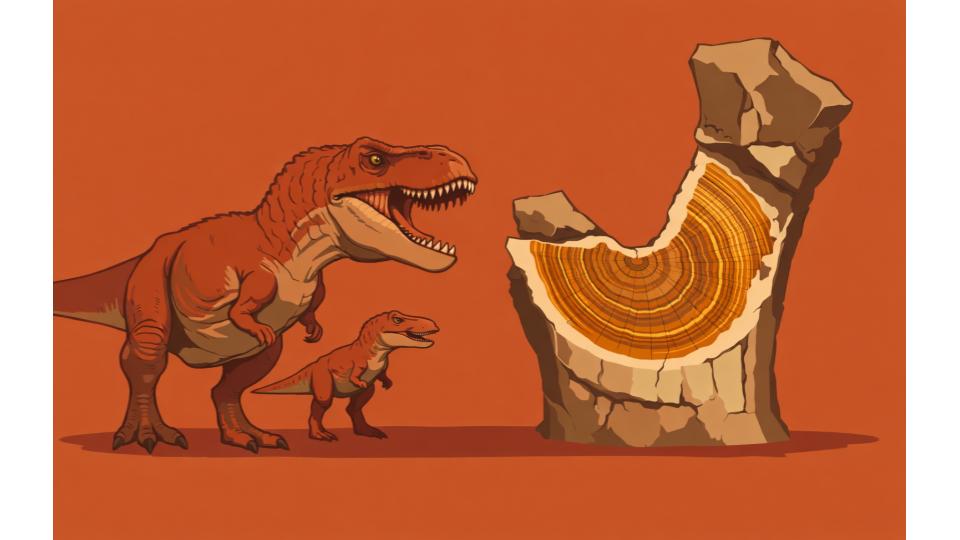
The method behind the study is elegant in its simplicity. Dinosaur bones, like the trunks of trees, record growth in annual rings. A thin slice of fossil bone examined under a microscope reveals bands of faster and slower growth, one for each year of the animal’s life.
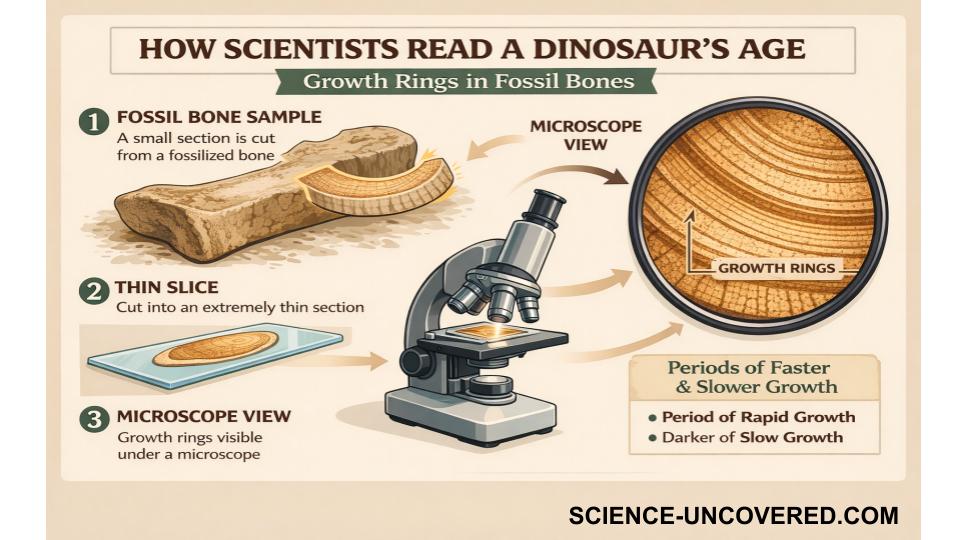
The problem is that a single slice of T. rex bone only captures the last 10 to 20 years of the animal’s life, not its entire history. It is as if someone handed you a tree stump with only the outer rings intact and asked you to figure out how old the tree was when it fell.
To get around this, the team developed a new statistical method that stitches together growth records from specimens of different ages, creating a composite growth curve covering the animal’s entire lifespan. It is the largest dataset ever assembled for T. rex.
The team also made an unexpected imaging discovery: when certain bones are examined under polarized light rather than standard light, previously invisible growth rings become visible. Those hidden rings had been throwing off earlier estimates for decades.
“Interpreting multiple closely spaced growth marks is tricky,” Myhrvold said in a statement. “We found strong evidence that the protocols typically used in growth studies may need to be revised.”
A Slow Climb to the Top
The revised picture of T. rex development is striking. Rather than surging to adult size within a couple of decades, the animal spent most of its life as a juvenile or adolescent, smaller, faster, and with a different hunting style than the bone-crushing giant it would eventually become.

Tyrannosaurus rex holotype specimen at the Carnegie Museum of Natural History, Pittsburgh.
Co-author Jack Horner of Chapman University argues this extended adolescence may actually explain how T. rex became so dominant. “A four-decade growth phase may have allowed younger tyrannosaurs to fill a variety of ecological roles within their environments,” Horner said in a statement. A young T. rex was not just a smaller version of the adult; it was effectively a different predator, competing for different prey.
Some Famous Fossils May Not Be T. Rex At All
Perhaps the study’s most provocative finding involves two of the most famous T. rex fossils in existence, nicknamed “Jane” and “Petey.” When the researchers plotted their growth curves against the other 15 specimens, Jane and Petey stood out sharply. Their growth patterns were statistically incompatible with the rest of the group.
The researchers are careful to say that growth data alone cannot settle the question of species identity. But the mismatch adds fuel to one of the longest-running debates in paleontology: whether Nanotyrannus, long dismissed as a juvenile T. rex, is actually a separate species.
A separate analysis by paleontologists Zanno and Napoli, using different techniques, reached the same conclusion, identifying Jane and Petey as belonging to two distinct Nanotyrannus species rather than young T. rex individuals.
If that interpretation holds up, it would mean that some of the fossils scientists have been using for decades to model T. rex growth and behavior were actually from a completely different animal.
Why It Matters
The study has implications well beyond T. rex. The new polarized-light imaging technique could be applied to other dinosaur species, potentially forcing a recalibration of growth estimates across the board. It also opens a new window into how large-bodied animals evolved and how an animal can dominate an entire age of Earth’s history not just by being big, but by spending most of its life being something else entirely.
The paper, “Prolonged growth and extended subadult development in the Tyrannosaurus rex species complex revealed by expanded histological sampling and statistical modeling,” was published on January 14, 2026, in PeerJ by Holly N. Woodward, Nathan P. Myhrvold, and John R. Horner.
Quotes in this article are drawn from a press release issued by PeerJ on March 5, 2026.

Jane holds a BSc in Biology from the University of Regina and a Master of Science in Bioscience, Technology and Public Policy from the Univesity of Winnipeg. Her reporting interests include Life Sciences, Physical Sciences and the Cosmos.