

Every thought you have, every memory you form, every decision you make begins with a conversation between neurons. Billions of brain cells talk to each other constantly, passing chemical signals across tiny gaps called synapses. For decades, scientists could only listen to one side of that conversation. They could detect when a neuron fired and sent a signal out. What they could not do was watch the incoming signals arrive.
That has now changed.
Researchers at the Allen Institute and HHMI’s Janelia Research Campus have engineered a protein that can detect incoming chemical signals at individual synapses in real time, inside a living brain. The findings were published in Nature Methods in December 2025.
The Missing Half of Every Neural Conversation
To understand why this matters, it helps to know how brain cells actually talk. A neuron sends an electrical pulse along its long branches until it reaches a synapse, the tiny gap between it and the next cell. That electrical signal cannot jump the gap. Instead, it triggers the release of chemical messengers called neurotransmitters. Glutamate is the most common of these, and it is central to learning, memory, and emotion.
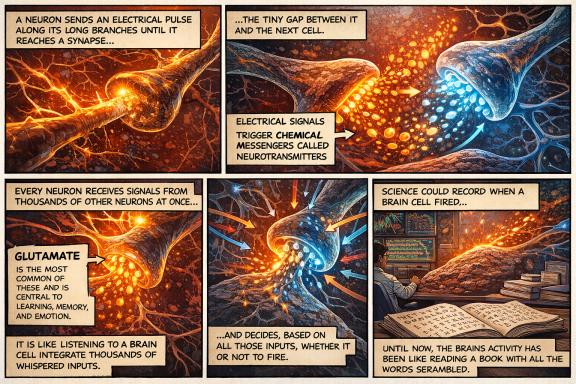
When glutamate lands on the receiving neuron, it can trigger that cell to fire and pass the signal along. But here is the key detail: each neuron receives signals from thousands of other neurons simultaneously. It is not a simple chain of falling dominoes. It is a brain cell integrating thousands of whispered inputs all at once and deciding, based on that combination, whether or not to fire.
Scientists have long been able to record when a neuron fires. What they could not do was see which incoming signals caused it to fire. Those inputs were too faint and too fast to detect in living tissue. The result was that neuroscience has been reading the brain’s activity like a book with all the words in the wrong order, able to see the individual letters but not the sentences they form.
The “Glue Sniffer” Protein
The new tool is called iGluSnFR4, pronounced “glue sniffer.” It is a engineered protein that glows when it binds to glutamate. Scientists attach it to neurons, then watch through a microscope as synapses light up the instant glutamate arrives. The glow reveals exactly where and when an incoming signal lands, at the resolution of a single synapse.
The sensor is sensitive enough to detect the release of a single vesicle of glutamate, a package containing only a few thousand molecules, which clears from the synapse in less than one millisecond.
“Neuroscientists have pretty good ways of measuring structural connections between neurons, and in separate experiments, we can measure what some of the neurons in the brain are saying, but we haven’t been good at combining these two kinds of information,” said Kaspar Podgorski, a lead author of the study and senior scientist at the Allen Institute, in a statement released by the institute. “What we have invented here is a way of measuring information that comes into neurons from different sources, and that’s been a critical part missing from neuroscience research.”
Podgorski offered another way to think about the gap the new tool closes. “It’s like reading a book with all the words scrambled and not understanding the order of the words or how they’re arranged,” he said. “I feel like what we’re doing here is adding the connections between those neurons and by doing that, we now understand the order of the words on the pages, and what they mean.”
What This Opens Up
The implications stretch well beyond basic neuroscience. Glutamate signalling is disrupted in Alzheimer’s disease, schizophrenia, autism, and epilepsy. Until now, researchers studying those conditions could see that something was going wrong in the brain’s communication network, but could not watch the malfunction happen at individual synapses in real time. That precision has been out of reach.
With iGluSnFR4, scientists can now observe exactly which synaptic connections are misfiring, which patterns of input are being disrupted, and whether a drug restores normal activity rather than relying on broad network signals or behavioural changes in animals.
The sensor has been made available to research labs worldwide through a biological materials repository called Addgene, meaning its impact will not be limited to the teams that built it.
Scientists have spent a century developing tools to listen to what neurons say. They can now finally hear what neurons are being told.
Quotes in this article are drawn from a press release issued by the Allen Institute in December 2025.
Sources
Abhi Aggarwal, Adrian Negrean, Yang Chen, et al. “Glutamate indicators with increased sensitivity and tailored deactivation rates.” Nature Methods, 23 December 2025. DOI: https://doi.org/10.1038/s41592-025-02965-z
Allen Institute press release: https://alleninstitute.org/news/scientists-develop-new-way-to-listen-in-on-the-brains-hidden-language/

Ray Jackson holds a BSc in Electrical Engineering from the University of Manitoba and a PhD in Physics from Carleton University. His reporting interests include Current and Future Technologies, Engineering and Artificial Intelligence.