
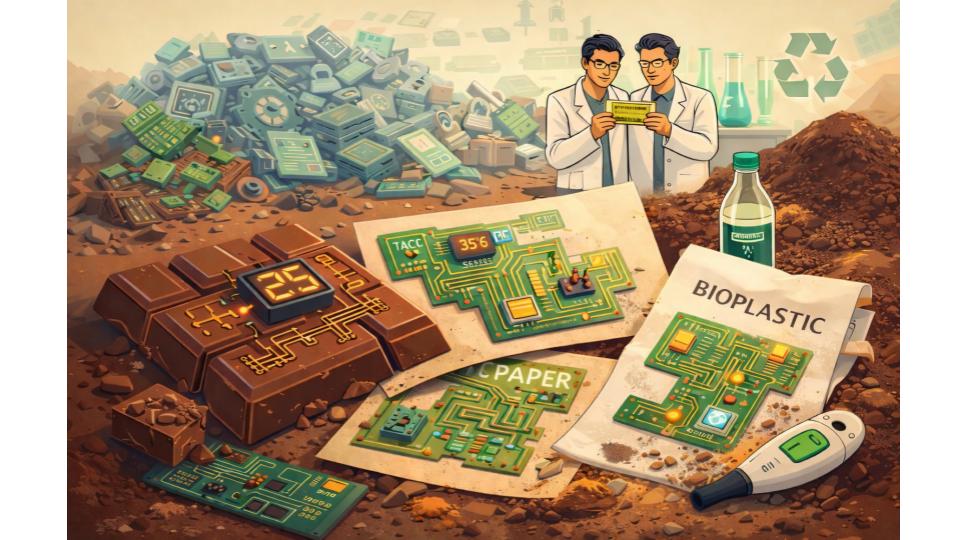
A University of Glasgow team has printed working circuits onto biodegradable substrates including paper, bioplastic, and chocolate. The boards match conventional performance and reduce environmental impact by up to 90 percent.
Pull apart any electronic device, a fitness tracker, a smart home sensor, a disposable medical monitor, and somewhere inside you’ll find the same thing: a flat green board covered in copper lines and tiny components. That board is a printed circuit board, or PCB. It is the skeleton of modern electronics.
It is also nearly impossible to get rid of safely.
When you throw away a device, the PCB almost certainly ends up in a landfill. The fiberglass base doesn’t break down. The copper leaches into the soil. The chemicals used to treat it during manufacturing don’t disappear. In 2024, the world generated 62 million tonnes of electronic waste. Less than 17 percent of it was recycled in the European Union. The circuit board sitting at the heart of all that waste has barely changed since the 1950s.
A team of engineers at the University of Glasgow thinks they’ve found a better way. And they demonstrated it, in part, by printing circuits onto chocolate.
The Problem With Copper
Standard circuit boards are built around two materials that create big problems at end of life. The first is fiberglass. Specifically a material called FR4, which is tough, heat-resistant, and essentially permanent. The second is copper, which forms the conductive tracks that connect components. Getting copper out of a discarded board requires either toxic chemicals or energy-intensive smelting. Most recyclers don’t bother.
The Glasgow team, led by Dr. Jonathon Harwell and Professor Jeff Kettle at the James Watt School of Engineering, asked a simple but radical question: what if you replaced both?
Their answer, published in January 2026 in the journal Communications Materials, uses zinc instead of copper and biodegradable materials; paper, bioplastics, even chocolate, instead of fiberglass. The result is a circuit board that, once you’re done with it, will dissolve in vinegar or compost safely in ordinary soil.
Ninety-nine percent of it vanishes without a trace.
How You Print Circuits on Chocolate
The manufacturing process is called a “growth and transfer additive manufacturing process,” which sounds complicated but follows a clever logic. First, the team electroplates zinc onto a temporary aluminum carrier — essentially growing the circuit pattern in metal, the same way you’d electroplate jewelry. The zinc tracks they produce are extraordinarily fine: just five microns wide, about one-twentieth the width of a human hair.
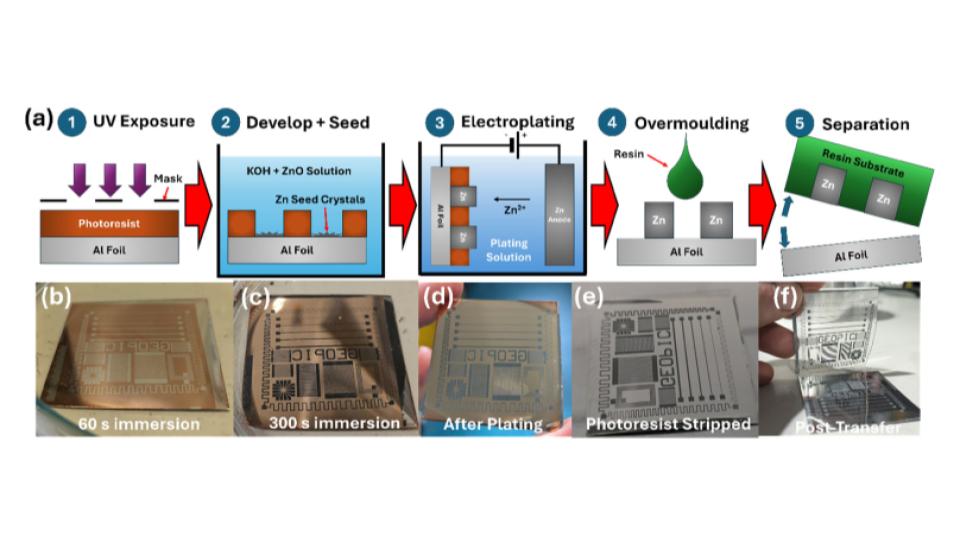
The process illustrated
Then, while a biodegradable base material is still in liquid form, they press the carrier into it. As the base sets, the zinc tracks embed themselves into it. The aluminum carrier peels away. What remains is a working circuit board on a compostable substrate.
The chocolate demonstration was partly a proof of concept, partly a point about flexibility. The method works on almost any surface you can form into a flat sheet. Paper, bioplastics, and chocolate all behaved essentially the same way. This means the process could adapt to an enormous range of applications.
More importantly, the circuits actually work. The team tested them in LED counters, tactile sensors, and temperature sensors, all of which performed comparably to devices built on conventional boards. They also left samples sitting at room temperature for over a year. Performance didn’t degrade.
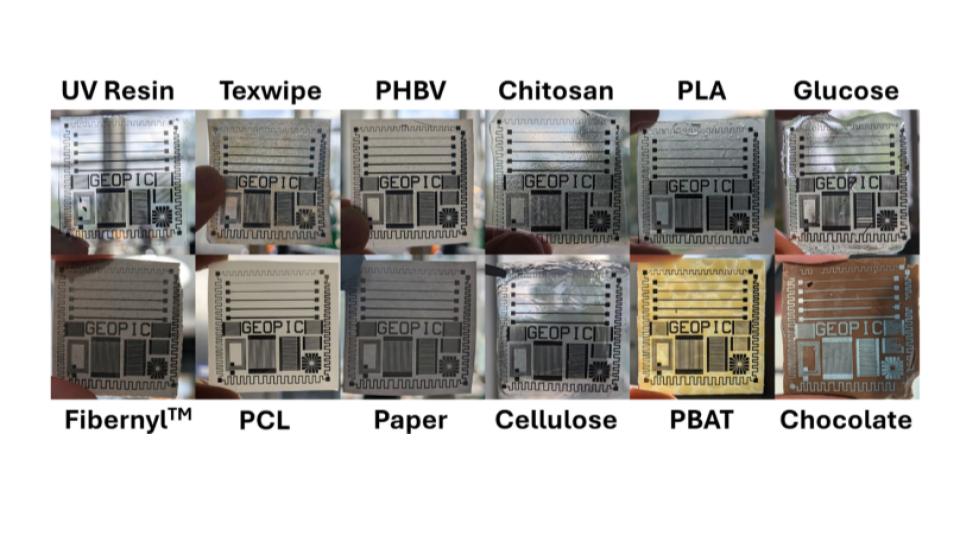
Circuit Boards on Various Substrate Materials
What Happens at the End
Here’s where the story gets genuinely remarkable. When a conventional circuit board reaches the end of its life, you face a problem: it was built to last forever. The materials that make it tough and reliable are the same materials that make it a hazard in a landfill.
The Glasgow boards were designed with the opposite philosophy. If you keep them dry, they last. Once exposed to water, soil, or household chemicals, the biodegradable base breaks down and the zinc dissolves. Zinc isn’t perfectly benign. It’s a heavy metal. But at the concentrations involved it’s far less harmful than copper, and unlike fiberglass it doesn’t persist in the environment for centuries.
The team ran a full life cycle assessment comparing their boards to standard copper-fiberglass PCBs of the same size. The biodegradable version showed a 79 percent reduction in global warming potential and a 90 percent reduction in resource depletion. Those aren’t marginal improvements. They’re a fundamental redesign of the environmental footprint.
In a statement released by the university, Dr. Harwell said: “The work demonstrates a major step toward circular electronics, where devices are designed from the outset for reuse, recycling, or safe degradation.”
Not for Your Laptop
It’s worth being clear about what this technology is and isn’t. It is not a replacement for the circuit board in your phone or laptop. High-end consumer devices demand boards that can survive heat, moisture, pressure, and years of continuous use. The biodegradable approach, at least for now, is aimed at a different category entirely.
Think about the explosion of single-use or short-life electronics: disposable medical sensors worn on the skin for a few days, agricultural monitors stuck in a field for a season, packaging with embedded freshness sensors, IoT devices deployed in the thousands and replaced annually. These devices end up in the trash by design. Today, each one leaves behind a small rectangle of permanent, hazardous waste. With biodegradable boards, they wouldn’t.
Professor Kettle pointed toward the next steps in a statement: the team is now exploring how the technique could extend to moldable electronics and biosensing; fields where cheap, flexible, low-footprint manufacturing would open entirely new possibilities.
A Different Way of Thinking
The deeper idea here isn’t just about materials. It’s about designing electronics the same way nature designs organisms — with their ending already built in. A tree doesn’t fight decomposition at the end of its life. It contributes to the next cycle.
For most of the electronics industry’s history, durability and disposability have been treated as opposites. You either built something to last, or you built something cheap that would become waste. The Glasgow team is proposing a third option: build something that performs, lasts as long as you need it, and then gracefully disappears.
The world generated 62 million tonnes of e-waste last year. Most of it was buried. Some of it will still be there in a thousand years.
A circuit board that composts in your garden – or, if the professors are feeling whimsical, in a bar of chocolate – is a quiet but serious argument that it doesn’t have to be that way.
Source: Harwell, J. et al., “Additively manufacturing printed circuit boards with low waste footprint by transferring electroplated zinc tracks,” Communications Materials (2026). DOI: 10.1038/s43246-025-01031-7

Ray Jackson holds a BSc in Electrical Engineering from the University of Manitoba and a PhD in Physics from Carleton University. His reporting interests include Current and Future Technologies, Engineering and Artificial Intelligence.