
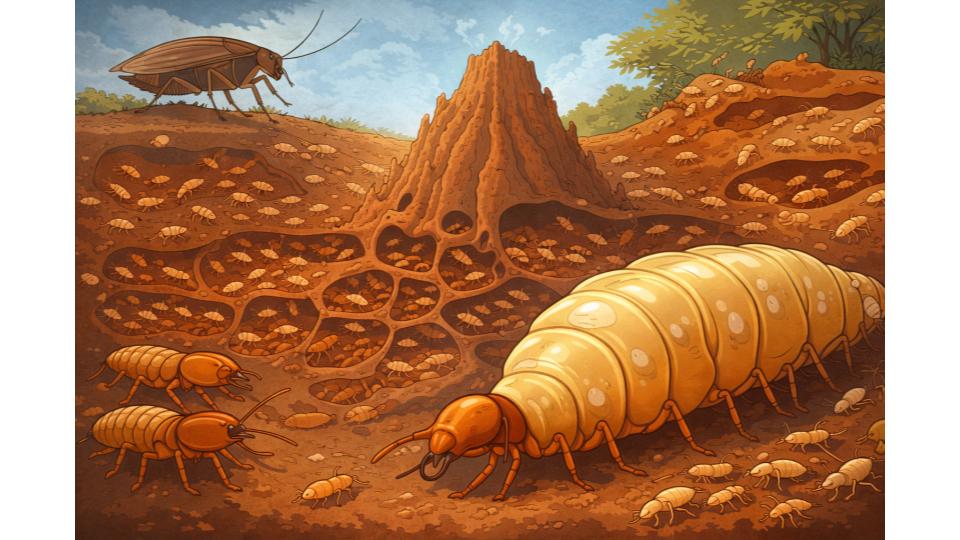
A large genomic survey of termites and their relatives shows that social complexity increased as genomes shrank, reversing a long-held assumption about evolutionary complexity.
SYDNEY — Termites evolved some of the most sophisticated societies on Earth by stripping genes from their genomes rather than adding new ones, according to a study published January 29 in Science. The findings challenge a widespread assumption that complex animal societies require increasingly complex genetics.
Researchers at the University of Sydney, working with collaborators from China, Denmark, and Colombia, sequenced and compared the full genomes of cockroaches, woodroaches, and multiple termite species ranging from simple to highly complex societies. It is the most comprehensive genomic survey of the group conducted to date.
The researchers found that termite and woodroach genomes are smaller and simpler than those of their cockroach ancestors. As social complexity increased across species, genome size decreased.
“The surprising result is that termites increased their social complexity by losing genetic complexity,” said Professor Nathan Lo, senior author and evolutionary biologist at the University of Sydney. “That goes against a common assumption that more complex animal societies require more complex genomes.”
Two gene losses drove the transition
The study identifies two categories of gene loss that played central roles in termite social evolution.
The first involves sperm competition. Solitary cockroaches produce elaborate, fast-swimming sperm that compete with those of rival males for fertilization. The genetic machinery needed to build these structures is complex. Termites lost those genes.
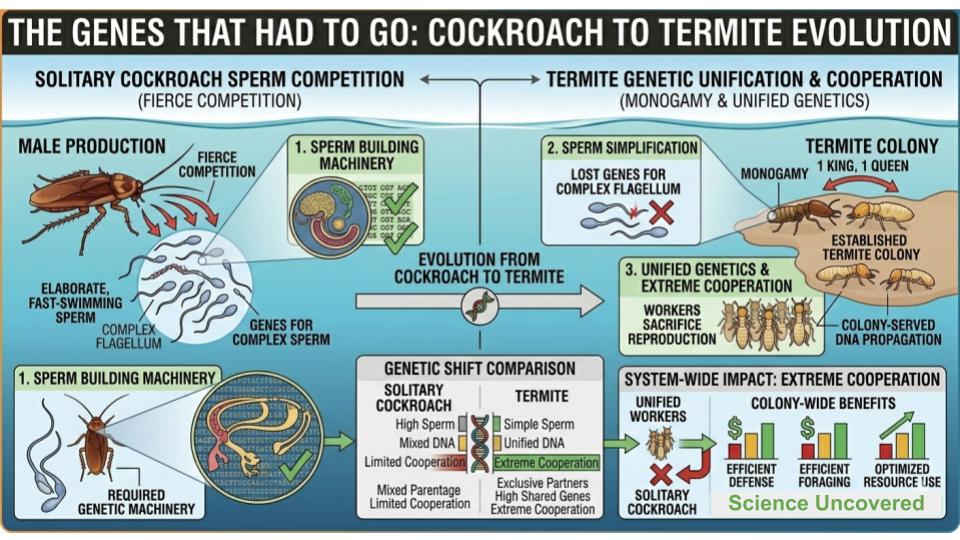
Without sperm competition, termite colonies operate under strict monogamy. A single king mates with a single queen for life, producing offspring that share a high proportion of their genes.
That genetic relatedness becomes the foundation of extreme cooperation. Workers that sacrifice their own reproduction to serve the colony are still passing on their DNA indirectly through their siblings. Natural selection can favor such self-sacrifice when parentage is consistent across the colony.
Lo noted that this dynamic strengthens further over time. In many termite species, when a king or queen dies, one of their offspring takes over the reproductive role, maintaining strong genetic relatedness within the colony across generations.
The second major gene loss involved individual metabolic independence. As early termites adapted to colony life and a wood-based diet, genes required for independent digestion became unnecessary.
Instead of each insect processing food alone, termites evolved a system in which food is shared and passed among colony members. The colony effectively operates as a collective digestive system, improving efficiency while reducing the need for complex metabolic pathways in each individual insect.
Role determination is driven by food, not genetics
The study also clarifies how termites develop into workers or reproductive individuals.
The determining factor is nutrition rather than genetics.
Larvae that receive abundant food early in development increase their metabolic activity and become workers. Larvae that receive less food develop more slowly and retain the ability to become kings or queens later in life.
“These food-sharing feedback loops allow colonies to fine-tune their workforce,” Lo said.
Because colony members feed one another, the colony can regulate how many workers and reproductives it produces. The same metabolic gene losses that eliminated individual digestive independence made this nutritional control possible.
Implications for evolutionary biology
The findings add to a growing body of evidence that complex social systems in animals do not always evolve through the accumulation of new genes.
For decades, evolutionary biologists debated whether sophisticated societies required new genetic innovations, larger brains, or more advanced communication systems. The termite genomic data suggests that complexity can sometimes emerge through the removal of traits rather than the addition of them.
“This work shows that understanding social evolution isn’t just about adding new traits,” Lo said. “Sometimes it’s about what evolution chooses to let go.”
The research team is continuing to investigate how food sharing, gene loss, and colony organization interact across termite species with different levels of social complexity.
Source: Cui, Y. et al., “Nutritional specialization and social evolution in woodroaches and termites,” Science (2026). DOI: 10.1126/science.adt2178

Jane holds a BSc in Biology from the University of Regina and a Master of Science in Bioscience, Technology and Public Policy from the Univesity of Winnipeg. Her reporting interests include Life Sciences, Physical Sciences and the Cosmos.