
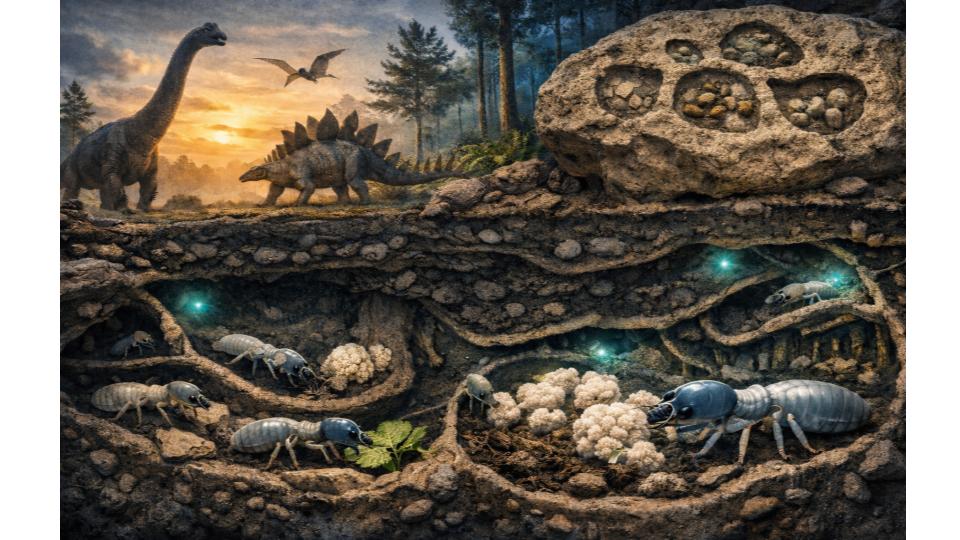
Fossilized nests from the Morrison Formation contain structures resembling modern fungal gardens, pushing the possible origin of insect agriculture deep into the age of dinosaurs.
SALT LAKE CITY — Researchers examining fossilized termite nests from Utah’s Morrison Formation have found structural evidence suggesting the insects were cultivating fungi during the Late Jurassic Period, approximately 150 million years ago, according to a 2026 study published in New Mexico Museum of Natural History and Science Bulletin.
If confirmed, the finding would push the known origin of termite fungus farming back by roughly 120 million years. The oldest previously confirmed fossil fungal gardens, found in Tanzania, date to approximately 25 million years ago. DNA studies of modern termites had placed the origin of the behavior at around 30 million years ago in an ancient African rainforest.
The fossilized nests, designated trace fossils called Eopolis ekdalei, were recovered near Green River, Utah from the Brushy Basin Member of the Morrison Formation, the same geological layer that has produced some of the most significant Jurassic dinosaur fossils on Earth, including Stegosaurus, Allosaurus, and Brachiosaurus.

The distictive banding of the Morrison Formation, a group of rock layers that occur throughout Dinosaur National Monument. Photo by Michael Overton.
“The Morrison Formation preserves an entire Jurassic ecosystem,” said lead author A. Rea, of the research team that conducted the scanning electron microscope analysis. “Finding evidence of complex insect agriculture within it changes what we thought we knew about the sophistication of Jurassic insect societies.”
What the fossils show
The nests are organized structures with branching galleries, chambers, and shafts whose architecture closely matches modern termite colonies. Researchers sliced and analyzed the fossils in detail using field emission scanning electron microscopy, which revealed small ellipsoid pellet-like structures distributed throughout the uppermost layers of the nests.
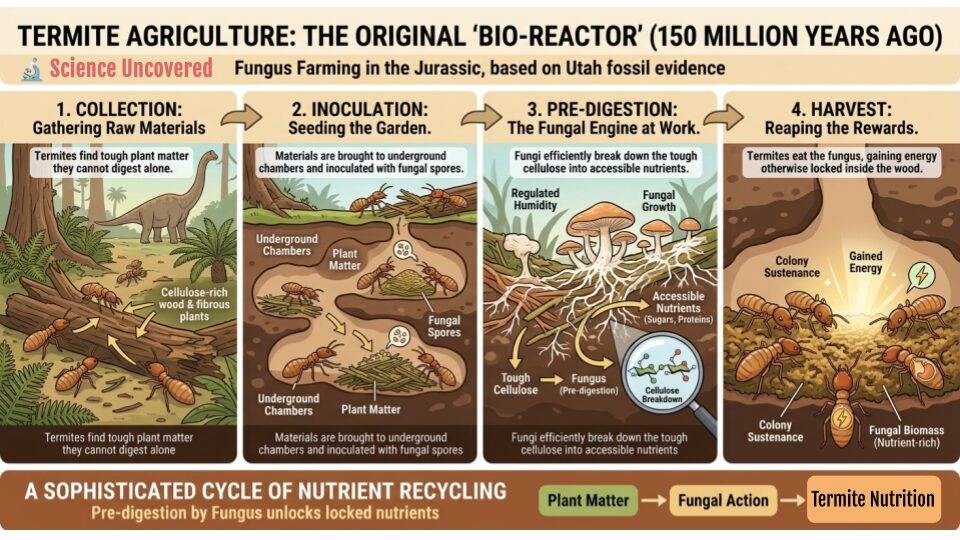
Those structures, composed of mud and organic material, closely resemble the fungal gardens that certain termite species maintain today. Modern fungus-farming termites gather plant material, bring it underground into specialized chambers, and inoculate it with fungal spores. The fungi break down tough cellulose into nutrients the termites can absorb. The termites tend the gardens, regulate humidity, remove waste, and harvest the fungus.
The researchers compared the chemical composition of the preserved structures to modern fungal gardens and placed them within a geological context that included earlier evidence of termite-like nesting from the same formation.
Supporting evidence from the same fossil layer
The study identifies a corroborating detail from the Morrison Formation. A small Jurassic mammal called Fruitafossor windscheffelia, found in the same geological layers, evolved powerful digging claws nearly identical to those of modern aardvarks and armadillos, animals that specialize in breaking into termite mounds.
The existence of an animal apparently adapted to raid termite nests in the same time and place as the fossilized nests strengthens the case that termite colonies were present and established enough to represent a reliable food source.
The longstanding debate over Jurassic termites
The possibility of Jurassic termites has been debated for decades. Researchers have periodically argued that fossilized nest structures in Jurassic and Triassic rocks could belong to early termites. Critics have pointed out that insect trace fossils are often ambiguous and that behavior is difficult to assign from structure alone.
The 2026 study advances the case through the level of analytical detail applied to the Morrison specimens, including chemical analysis of preserved nest material and systematic comparison with modern fungal garden structures. The authors acknowledge the finding remains subject to further verification.
Implications if the finding holds
Termite fungus farming is a form of true agriculture by standard biological definitions. The insects cultivate a specific organism, manage its growing conditions, and harvest it as a food source. If the behavior originated 150 million years ago rather than 30 million years ago, it predates flowering plants, resembles no modern continental geography, and places complex agricultural behavior among insects at a point when mammals were small nocturnal survivors living alongside dinosaurs.
The finding would also suggest that farming, one of the most cognitively and organizationally demanding behaviors in the animal kingdom, evolved independently multiple times across geological history, long before any human society developed it approximately 10,000 years ago.
Sources
Rea, A., Simpson, E.L., and Wizevich, M.C., 2026, A FESEM examination of Eopolis ekdalei, a eusocial ichnofossil, Brushy Basin Member, Late Jurassic Morrison Formation: evidence for preserved fungus in a fungal garden: in Foster et al., eds., New Developments in the Paleontology and Geology of the Upper Jurassic Morrison Formation: New Mexico Museum of Natural History and Science Bulletin 102, p. 347–358.
Armour Smith, E., Loewen, M.A., and Kirkland, J.I. (2020). New social insect nests from the Upper Jurassic Morrison Formation of Utah. Geology of the Intermountain West, v. 7, p. 281–299.

Ray Jackson holds a BSc in Electrical Engineering from the University of Manitoba and a PhD in Physics from Carleton University. His reporting interests include Current and Future Technologies, Engineering and Artificial Intelligence.