
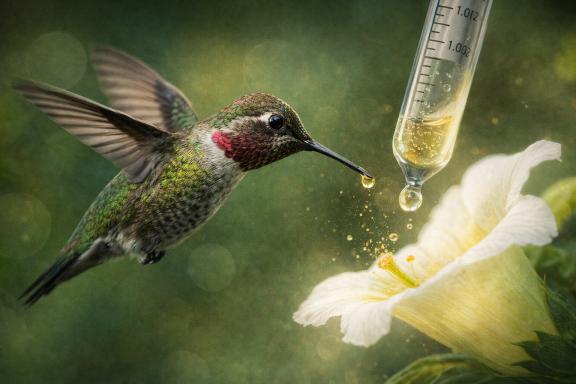
The first large survey of alcohol in flower nectar finds that most flowers naturally contain ethanol, that pollinators consume it constantly, and that hummingbirds metabolise the human equivalent of one alcoholic drink every single day without showing any sign of intoxication.
The hummingbird at your garden feeder is not just sipping sugar water. It is, in the most technical sense, drinking.
A new study from the University of California, Berkeley, has conducted the first broad survey of alcohol content in floral nectar and found that the flowers most animals rely on for energy are quietly laced with ethanol. Researchers detected ethanol in at least one nectar sample from 26 of the 29 plant species they tested, with most concentrations being trace amounts produced by yeast fermenting the sugars naturally present in the nectar. The findings were published in Royal Society Open Science.
The amounts involved are small. But the animals consuming them are small too, and they are drinking constantly.
The Maths of a Hummingbird’s Day
Hummingbirds consume between 50 and 150 percent of their entire body weight in nectar every single day. That is not a typo. These birds are essentially living engines that run on sugar, burning fuel at a rate that would be lethal for almost any other vertebrate. Their hearts beat over a thousand times per minute in flight. Their metabolic rate is roughly twelve times higher than a pigeon of equivalent size.
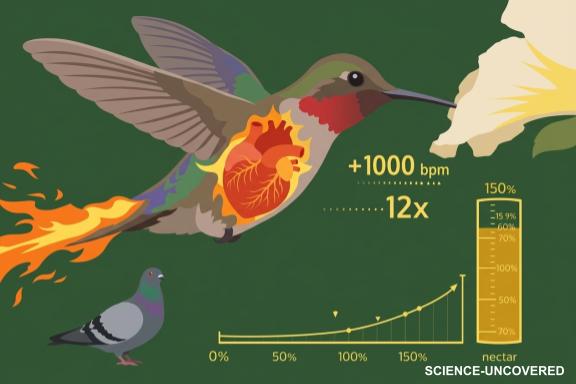
When researchers at Berkeley calculated what those consumption rates mean for daily alcohol intake, they found that an Anna’s hummingbird, commonly found along the Pacific coast, consumes roughly 0.2 grams of ethanol per kilogram of body weight per day, comparable to a human having about one alcoholic drink.
That comparison is worth pausing on. One drink equivalent, every day, from nothing but flowers.
The birds and bees consume the alcohol in small doses throughout the day and do not show clear signs of intoxication. No erratic flight. No loss of coordination. No impaired foraging. The alcohol appears to pass through their systems essentially without effect, burned off by a metabolism so rapid that nothing has time to accumulate.
“Hummingbirds are like little furnaces. They burn through everything really quick, so you don’t expect anything to accumulate in their bloodstream,” said doctoral student Aleksey Maro, who collected and analysed the nectar samples with postdoctoral fellow Ammon Corl, in comments released by Berkeley News.
How the Study Was Done
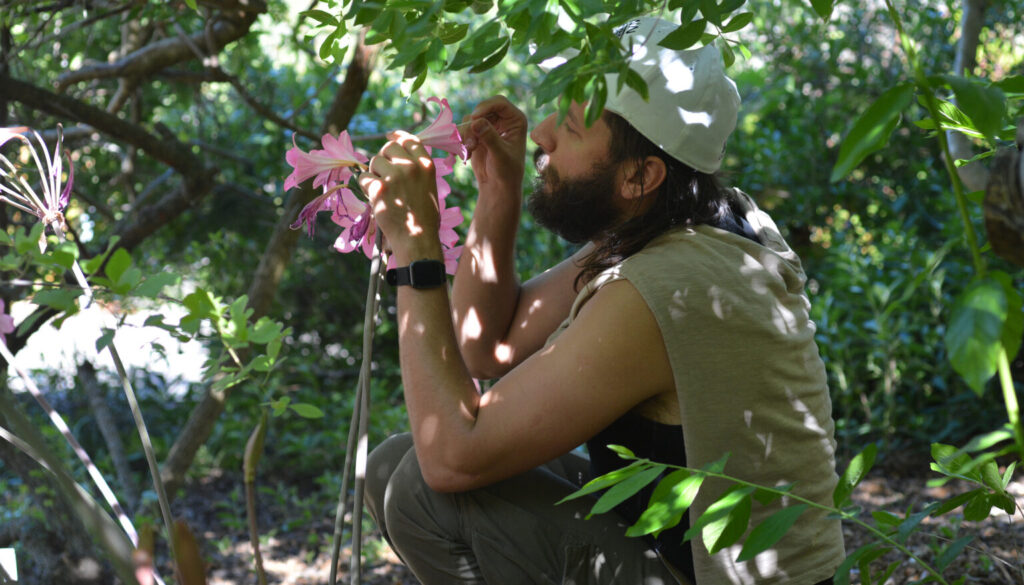
The research team collected nectar from 29 plant species flowering in the UC Botanical Garden, extracting samples using capillary tubes and measuring ethanol content using an enzymatic assay, the same type of test used in clinical and food science settings to detect alcohol in liquids.
Most samples had very low concentrations, almost certainly from yeast fermenting the sugars in the nectar, though one sample reached 0.056 percent ethanol by weight, roughly one tenth of a proof. For context, beer typically runs between 4 and 6 percent. The highest nectar concentration found in this study is about 100 times weaker than a light beer.
But those concentrations are consumed in extraordinary volumes relative to body size. The team then calculated daily ethanol intake for species for which reliable feeding data exists, focusing on the Anna’s hummingbird and the closely related sunbirds of South Africa, which occupy the same ecological niche as hummingbirds in the Americas.
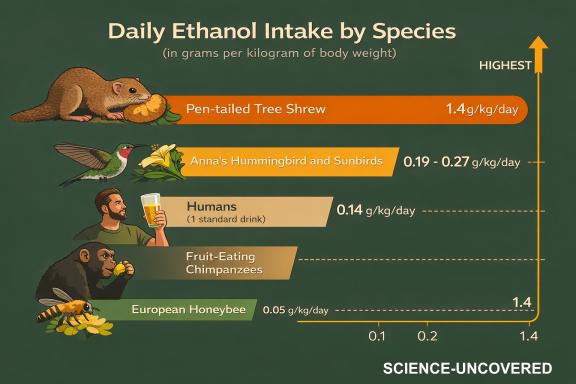
They compared these estimates with the calculated daily alcohol consumption of the European honeybee, the pen-tailed tree shrew, fruit-eating chimpanzees, and humans drinking one standard drink per day. The tree shrew had the highest intake at 1.4 grams per kilogram per day, while the honeybee had the lowest at 0.05 grams per kilogram per day.
Nectar-feeding birds fell in the middle of that range, roughly comparable to a human drinking one drink daily.
Three Lines of Evidence Converging on the Same Answer
This study is the third piece of a research programme that has been building a case for routine alcohol consumption in nectarivores over several years.
The first piece was a feeder experiment, in which the Berkeley team offered Anna’s hummingbirds sugar water spiked with varying concentrations of alcohol. Hummingbirds tolerated up to 1 percent alcohol without any reduction in visits, but began avoiding the feeder when concentrations rose above that level. This suggested the birds have a threshold, which implies they are actively sensing and regulating their ethanol intake rather than being indifferent to it.
The second piece came from a study led by former graduate student Cynthia Wang-Claypool, which found that feathers of Anna’s hummingbirds contain ethyl glucuronide, a metabolic byproduct of ethanol breakdown. This is the same compound used in human forensic toxicology to confirm alcohol consumption. Its presence in feathers confirmed that hummingbirds are not merely ingesting ethanol and passing it through unchanged, but actively metabolising it the way mammals do.
The new paper is the third piece: direct measurement showing that ethanol is actually widespread in the natural nectar these animals consume every day. “The laboratory experiment was showing that yes, they will drink ethanol in their nectar. The feathers are saying that yes, they will metabolise it. And then this study is saying that ethanol is actually pretty widespread in the nectar they consume,” said postdoctoral fellow Ammon Corl in comments released by Berkeley News.
What the Alcohol Might Actually Be Doing
The absence of obvious intoxication does not mean the alcohol is doing nothing. Nectar contains other compounds including nicotine and caffeine that are known to influence animal behaviour, and the same could be true of ethanol.
The researchers are careful to note that the full physiological picture is unknown. Ethanol at low concentrations could influence foraging behaviour, appetite, memory, or even flower preference in ways that would be very difficult to detect by observation alone. It could also have no behavioural effects whatsoever and simply represent an unavoidable side product of the fermentation chemistry that governs nectar composition.
“But we don’t know what kind of signalling or appetitive properties the alcohol has. There are other things that the ethanol could be doing aside from creating a buzz, like with humans,” Maro said in comments released by Berkeley News.
Professor Robert Dudley, the senior researcher who has led this line of work and who wrote the 2014 book The Drunken Monkey exploring the evolutionary origins of human alcohol consumption, sees the broader significance in terms of animal evolution. The fact that such a wide range of species, from insects to birds to tree shrews to primates, all consume and metabolise ethanol as a routine part of their diet suggests that tolerance for dietary alcohol is not a recent or uniquely human development but an ancient and widespread feature of animal biology.
The hummingbird outside your window, visiting the same flowers it has visited every day for its entire life, is operating within a system that has been quietly laced with alcohol for millions of years. It is, in every relevant sense, a well-practised drinker.
Sources
The paper, “Low-level ethanol is widespread within floral nectar,” was published March 25, 2026 in Royal Society Open Science by Aleksey Maro, Ammon Corl, and colleagues at the University of California, Berkeley, led by Professor Robert Dudley.
Quotes in this article are drawn from a press release issued by UC Berkeley on March 25, 2026.

Jane holds a BSc in Biology from the University of Regina and a Master of Science in Bioscience, Technology and Public Policy from the Univesity of Winnipeg. Her reporting interests include Life Sciences, Physical Sciences and the Cosmos.