
A chance discovery by climbers on an Italian cliff has given scientists a window into one of the strangest moments ever preserved in stone
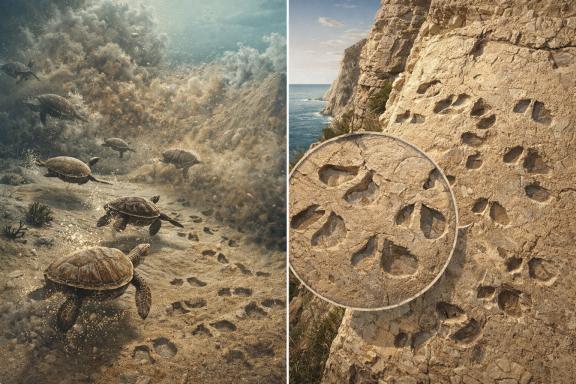
In the spring of 2019, a group of free climbers scaling the limestone cliffs of Monte Cònero on Italy’s Adriatic coast noticed something that stopped them mid-climb. The pale rock face in front of them was covered in strange curved shapes; hundreds of them, pressed into the stone like stamps. They looked exactly like footprints.
The climbers were not scientists, but they knew what they were looking at was unusual. They took photos. Those photos eventually reached a fellow climber who happened to be a geologist, Paolo Sandroni. He brought in Alessandro Montanari, director of the Coldigioco Geological Observatory, and a proper investigation began — drones, rock samples, microscopes, and all.
What they found has just been published in the journal Cretaceous Research. The tracks, they concluded, were made approximately 79 to 83 million years ago. And they were not left by animals wandering casually across the seafloor. They were left by a crowd of panicking sea turtles fleeing an earthquake.
More Than a Thousand Footprints
The main slab at Monte Cònero measures about 200 square metres — roughly the size of two tennis courts — and contains approximately 1,000 individual paddle-shaped impressions. Similar marks streak across nearby rock faces. The prints are dense, overlapping, and chaotic, arranged in a pattern that looks nothing like the leisurely traces of animals going about their daily lives.
The shapes are crescent grooves and round pits, consistent with the front flippers of a marine reptile pressing into soft seafloor mud. The researchers considered three candidates: plesiosaurs, mosasaurs, and sea turtles. Fish were ruled out because they do not use fins to push along the seafloor. Plesiosaurs and mosasaurs were largely solitary hunters and would not have produced this kind of dense, crowded pattern. Sea turtles, however, are known to gather in large groups, particularly when foraging near shallow water or coming ashore to lay eggs.
The sheer number of prints, roughly five per square metre, pointed firmly toward a group of animals moving together in the same direction at the same time. Not feeding. Not nesting. Running.
The Earthquake Clue
To understand why the turtles fled, the team looked at the rock directly above the track layer. What they found was a turbidite — a thick deposit laid down by a fast, violent underwater flow of sediment. Geologists recognise turbidites as the signature of sudden submarine avalanches, and in tectonically active regions like the ancient Apennine basin, those avalanches are most commonly set off by earthquakes.
The sequence of events the researchers pieced together goes like this. The sea turtles were gathered on or near the deep seafloor, possibly foraging near a shallow carbonate platform that rose above the surrounding basin. An earthquake struck. The seabed shook. The turtles bolted, pressing their flippers into the soft mud as they surged away from the disturbance.
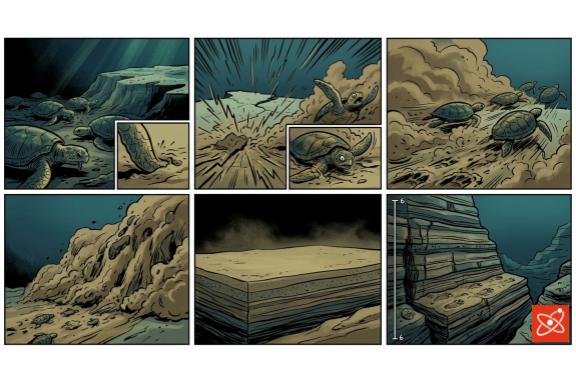
Then, within minutes, the earthquake triggered an underwater landslide. A dense wall of sediment roared across the seafloor and buried the track surface before currents, worms, or any other organism could disturb it. The tracks were sealed instantly, like a snapshot taken in mud and locked in stone for 80 million years.
“The footprints probably represent a stampede of panicking sea turtles that were mobilised en masse by an earthquake,” the researchers wrote.
Why This Almost Never Happens
Fossilised footprints from deep-sea environments are extraordinarily rare. On land, animal tracks can be preserved when mud dries and hardens before the next rain. On the deep ocean floor, nothing stays put for long. Currents disturb the surface. Burrowing animals churn through it. Any imprint made by a passing creature is typically erased within hours.
The Monte Cònero tracks survived precisely because the earthquake that frightened the turtles also caused the avalanche that buried their prints. The very disaster that sent them running is what preserved the evidence that they ran at all. Without the earthquake, there would be no record of the stampede. The footprints exist because of the catastrophe, not in spite of it.
Some Uncertainty Remains
The researchers are careful about what they can and cannot claim. No bones of sea turtles have been found at the site. No shells confirm the identification with certainty. Experts not involved in the study, including vertebrate palaeontologist Michael Benton of the University of Bristol, have raised questions about the exact pattern of movement and whether the tracks match what we would expect from sea turtle locomotion.
What the rock does show clearly, everyone agrees, is that a large number of animals moved rapidly across this seafloor in a short period of time, and that a sudden geological event preserved the evidence. Whether the trackmakers were definitively sea turtles or another marine reptile may require future discoveries to resolve.
A Cliff That Was Once an Ocean Floor
One detail in this story is easy to miss but worth pausing on. The rock face where the climbers found these prints is now a vertical cliff, hundreds of metres above sea level, overlooking the Adriatic coast. The seafloor where the turtles panicked 80 million years ago has been slowly folded, tilted, and pushed upward by tectonic forces over tens of millions of years until it became a mountain.
What was once the bottom of a deep ocean basin is now a limestone cliff in a regional park — closed to the public because of falling rock, accessible only to climbers with ropes. And it was those climbers, in 2019, who looked up at a vertical wall of ancient seafloor and recognised that something was written there.
Eighty million years of waiting, and it took a free climber with a good eye to finally read it.
Sources
The study was published in Cretaceous Research by Paolo Sandroni, Alessandro Montanari, and colleagues. DOI: 10.1016/j.cretres.2025.106268. Quotes in this article are drawn from the published paper and from associated press materials.
More Like This

Jane holds a BSc in Biology from the University of Regina and a Master of Science in Bioscience, Technology and Public Policy from the Univesity of Winnipeg. Her reporting interests include Life Sciences, Physical Sciences and the Cosmos.