
The fossil did not lie. It decomposed.
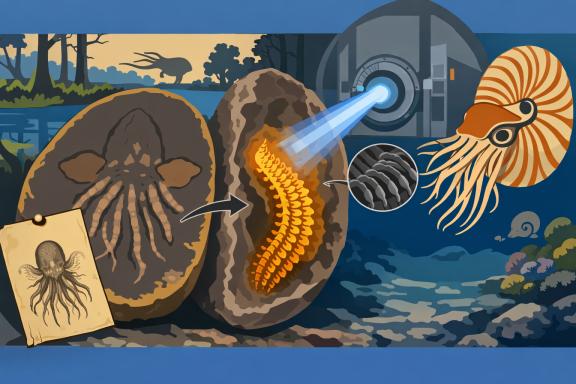
That distinction is at the heart of one of palaeontology’s most embarrassing mix-ups: a creature entombed in Illinois rock for 300 million years, celebrated for a quarter century as the world’s oldest known octopus, and listed in the Guinness Book of Records, has turned out to be something else entirely. Not because the original researchers were careless. Because the animal had been rotting for weeks before it was ever fossilised.
A team led by Dr. Thomas Clements at the University of Reading published findings this week in Proceedings of the Royal Society B showing that the fossil, known as Pohlsepia mazonensis, is not an octopus. It is a relative of the nautilus. The misidentification stood for 25 years because the evidence needed to correct it was hidden inside solid rock, waiting for technology that did not exist in 2000.
The Evidence Was Always There. Scientists Just Could Not See It.
The fossil was found at Mazon Creek in Illinois, a site where ancient organisms were buried so quickly that their soft tissue sometimes survived. When it was first described in 2000, researchers saw what looked like eight arms and fins. Octopus. Record set. Case closed.
Except the animal had been dead for weeks before it was buried. Its shell, the single most diagnostic feature of a nautiloid, had already dissolved during decomposition. Without the shell, the soft tissue collapsed and rearranged. The resulting blob looked, to a cephalopod researcher scanning a rock in the year 2000, convincingly like a deep-water octopus.
“To look at it, it kind of just looks like a white mush,” Dr. Clements said in a statement released by the University of Reading. “If you look at it and you are a cephalopod researcher and you’re interested in everything octopus, it does superficially look a lot like a deep-water octopus.”
The 2000 researchers were not wrong to identify what they saw. They were working without the tools to see what was actually there.
The Technology That Cracked the Case
What changed is synchrotron imaging, a technique that fires beams of light millions of times brighter than the sun through solid rock. The result is a detailed picture of structures inside the specimen that are completely invisible on the surface and cannot be reached without destroying the fossil.
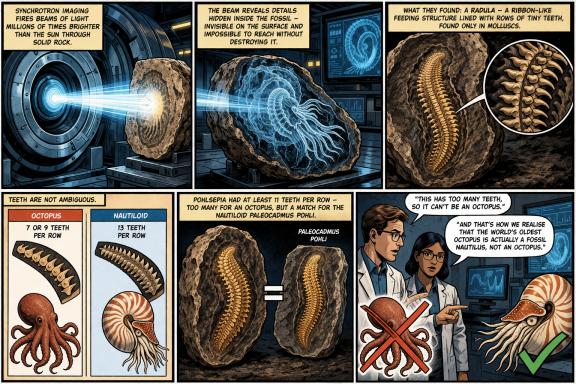
When Dr. Clements and his colleagues turned synchrotron beams on Pohlsepia, they found a radula: a ribbon-like feeding structure lined with rows of tiny teeth, found only in molluscs. Teeth are not ambiguous. Octopuses have seven or nine per row. Nautiloids have thirteen. Pohlsepia had at least eleven, far too many for an octopus, and matching a known nautiloid fossil from the same site called Paleocadmus pohli.
“This has too many teeth, so it can’t be an octopus,” Dr. Clements said. “And that’s how we realise that the world’s oldest octopus is actually a fossil nautilus, not an octopus.”
The Guinness Book of Records has confirmed it will remove the listing. The “oldest octopus” title has no current holder.
What This Changes
The reclassification does more than correct a single record. For 25 years, the existence of Pohlsepia meant scientists believed octopuses had been swimming in Earth’s oceans since the Carboniferous period, roughly 300 million years ago. With that fossil removed from the octopus column, the oldest confirmed octopus fossils now date to the Jurassic period, over 100 million years later.
The evolutionary split between octopuses and their ten-armed relatives, squids, also shifts accordingly, from the Palaeozoic era into the Mesozoic. The family tree of some of the most intelligent animals on Earth has just been substantially redrawn.
There is one small consolation. Pohlsepia did not lose its record entirely. Reclassified as a nautiloid, it now holds a different title: the oldest known example of preserved nautiloid soft tissue in the fossil record, beating the previous record holder by 220 million years.
One record taken. One record given. The fossil spent 300 million years in the dark, hiding the teeth that would eventually tell the truth.
Quotes in this article are drawn from a press release issued by the University of Reading on 8 April 2026.
Sources
Thomas Clements, Imran Alexander Rahman, Alan R. T. Spencer, Christian Klug, Dirk Fuchs, Isabelle Rouget, Isabelle Kruta, Sebastian Schöder, Jack Wittry, Orla G. Bath Enright, Pierre Gueriau. “Synchrotron data reveal nautiloid characters in Pohlsepia mazonensis, refuting a Palaeozoic origin for octobrachians.” Proceedings of the Royal Society B, 2026; 293 (2068): 20252369 DOI: https://doi.org/10.1098/rspb.2025.2369
University of Reading press release: https://www.reading.ac.uk/news/2026/Research-News/Oldest-octopus-fossil-is-no-octopus-at-all-scans-reveal

Jane holds a BSc in Biology from the University of Regina and a Master of Science in Bioscience, Technology and Public Policy from the Univesity of Winnipeg. Her reporting interests include Life Sciences, Physical Sciences and the Cosmos.