
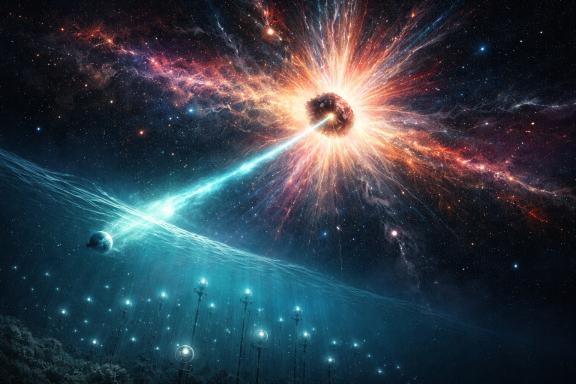
In February 2023, a particle slammed into a detector at the bottom of the Mediterranean Sea. It came from somewhere in the universe, travelled across an unknown distance, and arrived carrying an energy so extreme that no known cosmic process should have been able to produce it.
The particle was a neutrino. Its energy was 220 peta-electron-volts, roughly 100,000 times more powerful than anything ever produced by the Large Hadron Collider, the world’s most powerful particle accelerator. Nothing in any physicist’s catalogue of stars, explosions, or cosmic events could account for it.
Scientists have now proposed an explanation. And if it is right, this single particle may be the first direct evidence of one of the most famous predictions in physics: that black holes explode.
A Relic From the Big Bang
Physicists at the University of Massachusetts Amherst published a new study in Physical Review Letters suggesting the 220 PeV neutrino was produced by the violent death of a primordial black hole, a type of black hole formed not from a collapsing star but from the extreme density of the universe in the first moments after the Big Bang.
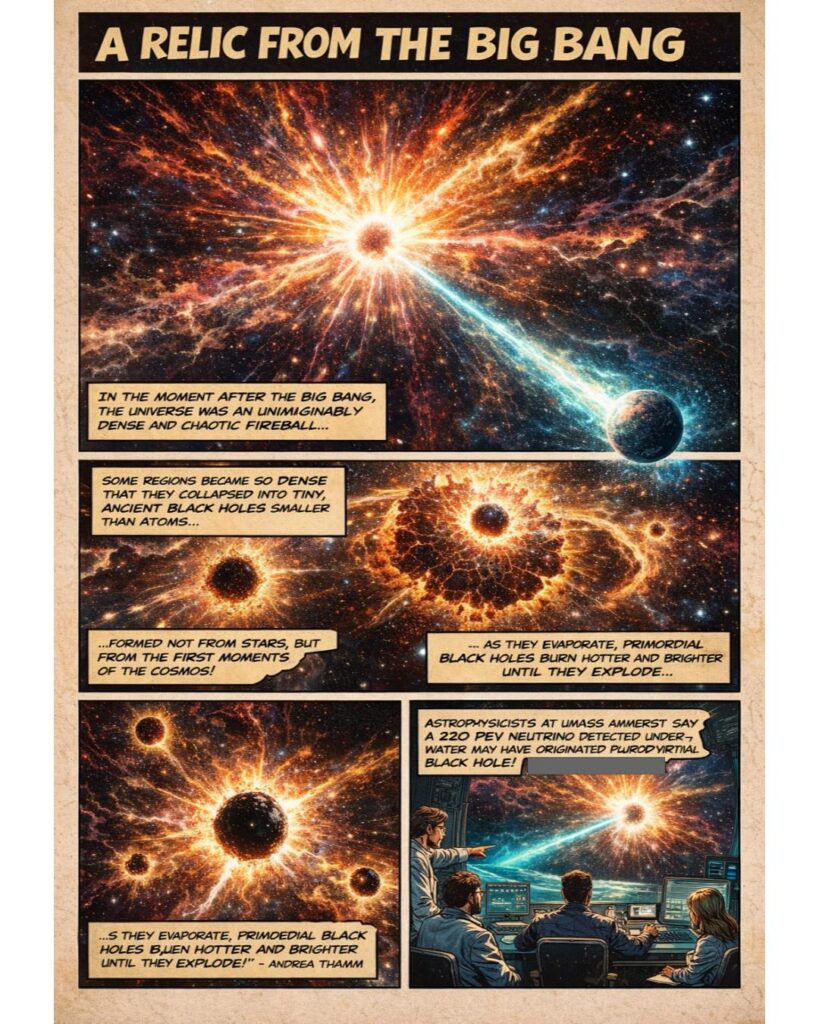
These objects have never been observed. They are thought to be tiny, with some smaller than an atom, and are believed to have formed when regions of matter in the early universe were so tightly packed that they collapsed under their own gravity. Some physicists think they may make up a significant fraction of the dark matter that holds galaxies together.
What makes primordial black holes different from the black holes formed by dying stars is their size. Small black holes are hot. Very hot. And according to a theory proposed by Stephen Hawking in 1974, all black holes slowly leak energy as radiation and eventually evaporate completely. For large stellar black holes, this process takes longer than the current age of the universe. For a tiny primordial black hole, it ends in an explosion.
“The lighter a black hole is, the hotter it should be and the more particles it will emit,” said Andrea Thamm, a co-author of the study and assistant professor of physics at UMass Amherst, in a statement released by the university. “As primordial black holes evaporate, they become ever lighter, and so hotter, emitting even more radiation in a runaway process until explosion. It is that Hawking radiation that our telescopes can detect.”
Why One Detector Saw It and Another Did Not
Part of what makes the 2023 event so puzzling is the silence from IceCube, a neutrino detector embedded deep in Antarctic ice at the South Pole. IceCube is larger than KM3NeT and has been operating longer, yet it never detected a neutrino anywhere near this energy.
The UMass team’s model explains this. Their calculations suggest a primordial black hole with a hidden “dark charge” would produce a specific pattern of neutrino energies: many events in the 1 PeV range and occasionally one extreme outlier at 100 PeV or above. IceCube is sensitive to the lower-energy events, which it has indeed detected. KM3NeT happened to catch the rare high-energy outlier.
The two detectors are not contradicting each other. They are observing different parts of the same population, produced by ancient black holes exploding throughout the Milky Way.
The Stakes
If the theory holds, the implications run far beyond explaining one unusual particle. Hawking radiation has been one of the most important theoretical predictions in all of physics for half a century, but it has never been directly observed. A confirmed primordial black hole explosion would change that.
It could also offer a new window into dark matter. If primordial black holes with hidden charge make up part of the universe’s dark matter budget, future neutrino detectors could search for the specific pattern their explosions would leave in the neutrino sky.
“Observing the high-energy neutrino was an incredible event,” said lead author Michael Baker in a statement released by UMass Amherst. “We could now be on the cusp of experimentally verifying Hawking radiation, obtaining evidence for both primordial black holes and new particles beyond the Standard Model, and explaining the mystery of dark matter.”
The team estimates that primordial black hole explosions may occur roughly once per decade within range of our detectors. We may have already caught one without knowing it.
Sources
Michael J. Baker, Joaquim Iguaz Juan, Aidan Symons, Andrea Thamm. “Explaining the PeV Neutrino Fluxes at KM3NeT and IceCube with Quasiextremal Primordial Black Holes.” Physical Review Letters, 2026; 136 (6) DOI: https://doi.org/10.1103/r793-p7ct
Quotes in this article are drawn from a press release issued by the University of Massachusetts Amherst on 8 April 2026.

Ray Jackson holds a BSc in Electrical Engineering from the University of Manitoba and a PhD in Physics from Carleton University. His reporting interests include Current and Future Technologies, Engineering and Artificial Intelligence.