
Every battery ever built shares one fundamental limitation: make it bigger, and it does not charge any faster. Scientists just built one that does.
Every battery you have ever used gets harder to scale up. Make it larger, and the trade-offs multiply: more weight, more heat, more complexity, and no fundamental improvement in how quickly it charges. That relationship has been taken for granted since Alessandro Volta built the first battery in 1800.
A team of Australian scientists just broke it.
Researchers from CSIRO, RMIT University, and the University of Melbourne have built the world’s first working prototype of a quantum battery, a device that stores and releases energy using the rules of quantum physics rather than chemistry. The findings were published in the journal Light: Science & Applications.
The most striking result is not just that it works. It is what happens when it grows. Unlike every conventional battery ever made, this device charges faster as it gets larger. The bigger the quantum battery, the quicker it fills up.
“Our study found quantum batteries charge faster as they get larger, which is not how today’s batteries work,” said Daniel Tibben, a PhD candidate at RMIT and co-author of the study. “It’s a sign that quantum batteries could one day outperform conventional energy-storage technologies.”
What Makes It Quantum
Ordinary batteries, whether lithium-ion in a smartphone or lead-acid in a car, store energy through chemical reactions. Charged molecules swap electrons, energy gets locked in, and the process is reversed when you plug something in. It works, but it has limits baked into the chemistry itself.
Quantum batteries work on entirely different principles. They exploit phenomena called superposition and entanglement, two features of quantum mechanics that have no equivalent in the everyday world. Superposition allows quantum particles to exist in multiple states simultaneously. Entanglement links particles together so that what happens to one instantly affects another, regardless of distance. Together, these effects allow quantum batteries to transfer and store energy in ways that ordinary physics does not permit.
The conventional battery equivalent would be filling a swimming pool with a garden hose: more volume just means more time. A quantum battery, in theory, works more like adding more hoses simultaneously as the pool grows. The scaling relationship flips.
The Prototype
The device built by the team is small: a layered structure made from organic materials, designed to work at room temperature without the extreme cooling that quantum experiments often require. Room-temperature operation is significant because it moves quantum batteries out of the category of lab curiosities that only function in specialised environments and into something that could eventually be engineered into practical devices.
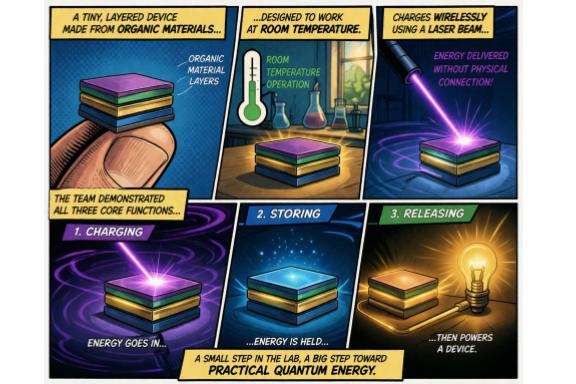
It charges wirelessly, using a laser. Energy is delivered without any physical connection between the source and the battery. The team demonstrated all three core functions: charging, storing, and releasing energy.
“We demonstrated a device that can be charged, store that energy and then discharge it,” said Professor Daniel Gómez, a co-author and RMIT Professor of Chemical Physics. “This is an exciting development in a rapidly growing interdisciplinary field. Hopefully quantum batteries will soon no longer be a theoretical idea but something that can be built in the lab.”
What Comes Next
The research was led by Dr. James Quach, a Science Leader at CSIRO, Australia’s national science agency. Quach described the prototype as a proof of concept, an important first step rather than a finished product.
“Our proof-of-concept device showcases rapid, scalable charging and energy storage at room temperature, laying the groundwork for next-gen energy solutions,” he said in a statement released by RMIT University. “While there’s still much work to be done in quantum battery research, we’ve made an important move towards realising the possibilities.”
The team is now working on extending how long the battery can hold its charge. At this stage, the device can store energy, but keeping it stored for practically useful lengths of time remains a challenge to be solved. That gap between proof of concept and commercial product is real and will take years to close.

Quach has made clear where he wants to eventually arrive. “My ultimate ambition is a future where we can charge electric cars much faster than fuel petrol cars, or charge devices over long distances wirelessly,” he said.
Why It Matters
Battery technology has not seen a fundamental shift in its underlying physics since the nineteenth century. Lithium-ion cells, which power nearly every portable device in the world today, are a refinement of established electrochemistry rather than a break from it. Quantum batteries represent a genuinely different approach, one where the laws of quantum mechanics are doing the work instead of chemical reactions.
The scaling advantage alone, if it holds as the technology matures, would address one of the biggest limitations of current batteries. Electric vehicles and grid-scale energy storage both suffer from the fact that charging speed does not keep pace with capacity. A technology that charges faster precisely because it is larger would rewrite the economics of both.
That future is not imminent. Quantum batteries remain early-stage and fragile, and the gap between a working prototype and a product in a device is large. But for the first time, the prototype exists, it charges, stores, and releases energy, and it does something no battery in history has done before.
It gets better as it grows.
Sources
Kieran Hymas, Jack B. Muir, Daniel Tibben, Joel van Embden, Tadahiko Hirai, Christopher J. Dunn, Daniel E. Gómez, James A. Hutchison, Trevor A. Smith, James Q. Quach. “Superextensive electrical power from a quantum battery.” Light: Science & Applications, 2026; 15 (1)
Quotes in this article are drawn from a press release issued by RMIT University on 4 April 2026.

Ray Jackson holds a BSc in Electrical Engineering from the University of Manitoba and a PhD in Physics from Carleton University. His reporting interests include Current and Future Technologies, Engineering and Artificial Intelligence.