
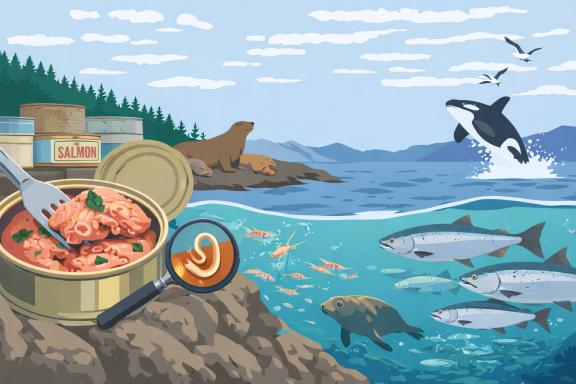
Scientists who opened decades of archived tins made a discovery that flips everything you thought you knew about parasites
When a Seattle trade association called the University of Washington to ask whether anyone wanted boxes of expired canned salmon, Chelsea Wood said yes without hesitation. Not because she was hungry. Because she suspected the tins might contain worms.
She was right. And what those worms revealed has given marine scientists something they have wanted for decades: a window into the health of Alaska’s oceans stretching back more than forty years.
Wood is a parasite ecologist at the University of Washington. She and her then-doctoral student Natalie Mastick had spent months trying to solve a stubborn problem. They wanted to know how parasite levels in Pacific salmon had changed over time, because parasites can tell you things about an ecosystem that almost nothing else can. But you cannot travel back to the 1970s to collect fish samples. They needed a different way in.
The Seafood Products Association gave them one. The Seattle-based trade group had been setting aside a small number of canned salmon tins each year for quality control, then storing them in a warehouse. When they no longer needed the collection, they asked whether any researchers might find it useful. Wood and Mastick took the call and never looked back.
A Warehouse Full of Scientific Gold
The archive contained 502 cans of four Alaskan salmon species, all caught between 1979 and 2021 in the Gulf of Alaska and Bristol Bay. The team selected and dissected 178 of them. Their method was painstaking: pull each fillet apart with forceps, examine every section under a dissecting microscope, and count the number of parasitic worms embedded in the flesh.
The worms they were looking for are called anisakids, sometimes known as sushi worms. They are tiny roundworms, about one centimetre long, that curl up inside the muscle of marine fish. The canning process kills them completely, so they pose no risk to anyone who eats the salmon. But preserved in tin, they turned out to be perfect ecological records.
Across 178 cans, the team found 372 worms. Half of all the cans they opened contained at least one.
Why More Worms Is Better News
Here is the counterintuitive part. Anisakids cannot complete their life cycle alone. They start in the ocean as free-floating larvae, get eaten by tiny crustaceans like krill, move into fish like salmon when those crustaceans are eaten, and then need one final host to reproduce: a marine mammal. A seal, a sea lion, an orca. Only in the intestines of a marine mammal can the worms lay eggs and release them back into the ocean to begin the cycle again.
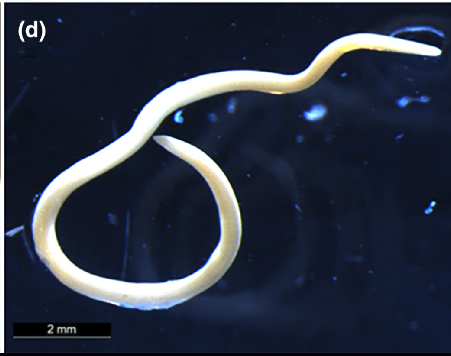
That dependency makes anisakids a remarkably sensitive ecological gauge. If marine mammals disappear from an ecosystem, the parasite cannot finish its life cycle and its numbers drop. If marine mammals are present and thriving, worm numbers rise.
“Everyone assumes that worms in your salmon is a sign that things have gone awry,” said Wood. “But the anisakid life cycle integrates many components of the food web. I see their presence as a signal that the fish on your plate came from a healthy ecosystem.”
What the Tins Revealed
The results showed a clear split. In chum and pink salmon, anisakid levels rose significantly between 1979 and 2021. In coho and sockeye, they stayed flat.
The rise in chum and pink salmon points toward ecosystem recovery. The leading explanation is the Marine Mammal Protection Act of 1972, which banned the hunting and harassment of marine mammals in American waters. In the years after the law passed, populations of seals, sea lions, and orcas began slowly recovering. By 1979, when the first cans in the study were sealed, that recovery was already underway. The rising worm count in subsequent decades appears to track those returning animals.
“Anisakids can only reproduce in the intestines of a marine mammal,” said Mastick, who is now a postdoctoral researcher at Yale’s Peabody Museum of Natural History. “So this could be a sign that, over our study period, anisakid levels were rising because of more opportunities to reproduce.”
Why coho and sockeye showed no change remains an open question. Different anisakid species tend to infect different salmon, and each relies on its own combination of hosts. The canning process preserved the worms’ outer shells but destroyed the internal anatomy needed to identify individual species, leaving that puzzle unsolved for now.
A New Tool for Reading the Past
The study, published in Ecology and Evolution, has opened the door to a new kind of marine science. Wood and Mastick are now working on an extended research grant to test whether the same approach could work with other archived seafood: herring, anchovies, halibut, tuna. The limiting factor is finding comparable archives. The Seafood Products Association’s decades-long quality control collection was unusually complete. But if similar stashes exist elsewhere, the worms inside could be telling their own stories.
The ocean has been changing for a long time. It turns out the evidence was sitting in a warehouse in Seattle, waiting for someone to say yes to a phone call about expired fish.
Sources
Quotes in this article are drawn from a press release issued by the University of Washington on April 1, 2026, and from the original study published in Ecology and Evolution (DOI: 10.1002/ece3.11043). The research was funded by the National Science Foundation, the Alfred P. Sloan Foundation, the Washington Research Foundation, and the University of Washington.

Jane holds a BSc in Biology from the University of Regina and a Master of Science in Bioscience, Technology and Public Policy from the Univesity of Winnipeg. Her reporting interests include Life Sciences, Physical Sciences and the Cosmos.