
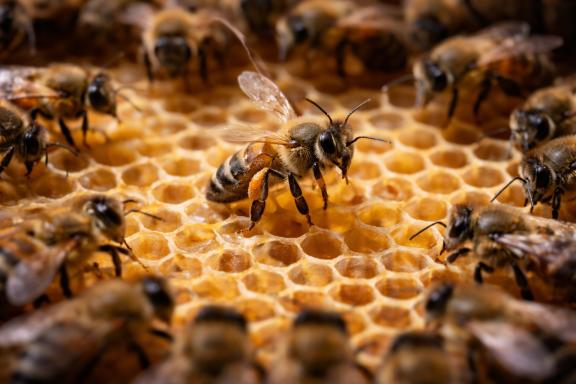
When a bee loses its audience, its directions to the food get fuzzier. The finding rewrites what we thought we knew about insect communication and raises uncomfortable questions about how smart a sesame-seed-sized brain really is.
Inside a beehive, information travels by dance.
When a foraging honey bee finds a promising patch of flowers, it does not simply fly back and tell its nestmates where to go. It performs. On a section of comb called the dance floor, the bee launches into a precisely choreographed figure-eight, waggling its abdomen as it runs forward, looping back, and doing it again. The angle of the waggle run encodes direction, aligned relative to the sun. The duration of each run encodes distance. If a watching bee interprets the dance correctly, it can fly out and find food it has never seen, guided entirely by directions received through its antennae and feet.
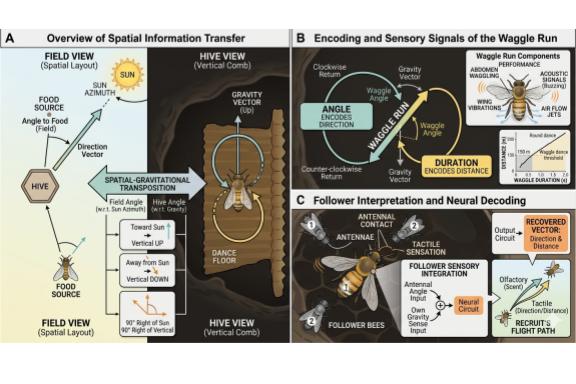
Scientists have been decoding this system for decades. But a new study published in the Proceedings of the National Academy of Sciences has revealed something nobody expected: the quality of those directions depends not just on the dancer, but on who is watching. When the audience shrinks, the dance gets worse.
The experiment that changed the picture
Researchers from the University of California San Diego, the Chinese Academy of Sciences, and Queen Mary University of London set up observation hives, glass-walled colonies where they could watch every move on the dance floor. Then they started manipulating the crowd.
In the first set of experiments, they simply reduced the number of bees available to follow dances. As the audience thinned, dancers became measurably less precise. The angles of their waggle runs varied more from one circuit to the next, and the duration of each run became less consistent. Recruited foragers following an imprecise dance get fuzzier directions and are less likely to find the food.
The second experiment was more revealing. The team kept the total number of bees on the dance floor the same, but swapped in young worker bees who are developmentally too immature to follow dances. The floor looked just as busy. But the dance fell apart in exactly the same way.
This ruled out the possibility that the bee was simply responding to crowding or general hive noise. It was tracking something specific: the presence of appropriately aged, attentive followers. When they were gone, even if the floor was packed, the performance deteriorated.
The mechanism is not what you might expect
The intuitive explanation would be that a bee, sensing a small audience, deliberately dials back its effort. But the researchers found something more interesting. The precision loss appears to be a side effect, not a choice.
When followers become scarce, the dancer searches. During the looping phase between waggle runs, a bee with few followers moves more widely across the dance floor, covering greater distances trying to find and re-engage an audience.
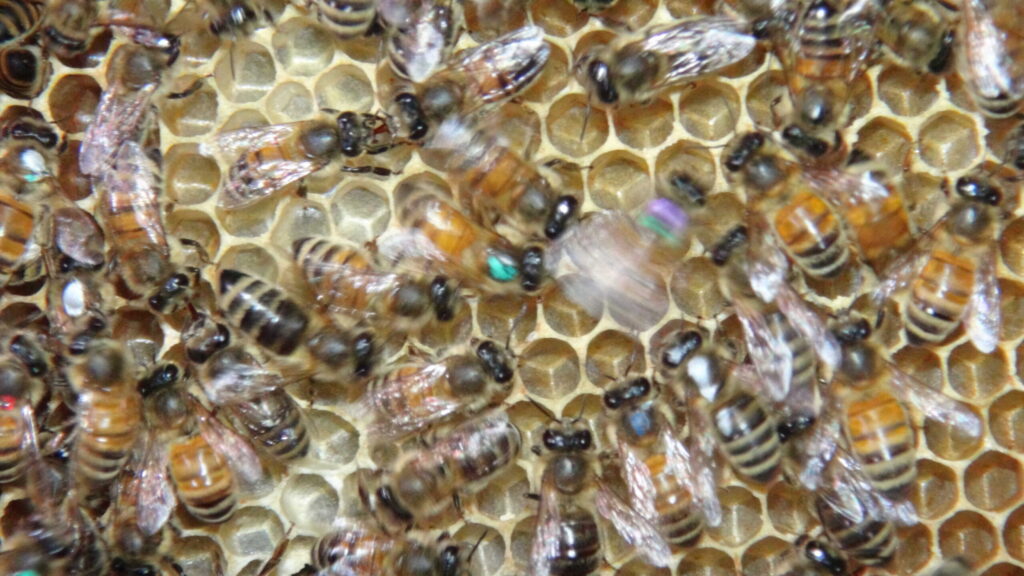
That extra movement disrupts the motor program that makes the waggle run precise. Maintaining a fast, repeatable, carefully calibrated physical movement while simultaneously searching for someone to perform for turns out to be physically difficult. The directions get fuzzier because the dancer is motorically distracted, not cognitively, but physically unable to do both things well at once.
How does a bee know its audience is shrinking?
It feels them. Other bees make frequent contact with the dancer using their antennae and bodies throughout the performance. The researchers believe these touches act as a real-time tactile census of how many engaged followers are present. This is a version of quorum sensing, the same class of mechanism bacteria use to detect population density in their environment. In honey bees, it appears to shape the quality of navigation instructions delivered to the entire colony.
Why this matters beyond the hive
Before this study, the phenomenon scientists call the audience effect, an animal adjusting its communication based on who is watching, had been documented only in vertebrates. Birds sing differently when rivals are present. Chimpanzees modify their calls based on the social status of nearby individuals.
This study provides the first direct evidence that information encoding in the waggle dance is modulated by feedback from receivers, an audience effect that has largely been overlooked in animal communication research.
A honey bee brain contains roughly one million neurons. A human brain contains about 86 billion. And yet the bee is producing behaviour that, functionally, looks like something we previously reserved for animals with far more hardware. Lars Chittka of Queen Mary University of London said in a statement released by UC San Diego that the findings show honey bees “quite literally dance better when they know someone is watching. When followers are scarce, dancers wander around searching for listeners and in doing so, their signals become fuzzier. It’s a lovely reminder that even in the miniature world of insects, communication is a deeply social affair.”
Ken Tan, the senior author of the study and a researcher at the Xishuangbanna Tropical Botanical Garden of the Chinese Academy of Sciences, said in a statement released by UC San Diego: “The waggle dance is often presented as a one-way information transfer. Our data show that feedback from the audience shapes the signal itself. In that sense, the dancer is not only sending information, but also responding to social conditions on the dance floor.”
The dance, in other words, is not a broadcast. It is a conversation in which the audience has always had a say, even if scientists are only now beginning to listen.
Sources
Lin, T., Dong, S., Gu, G., Zhang, F., Ye, X., Wang, T., Wang, Z., Li, J., Nieh, J.C., Chittka, L. and Tan, K. (2026). The audience shapes the information content of the honey bee waggle dance. Proceedings of the National Academy of Sciences, 123(14). https://doi.org/10.1073/pnas.2518687123
Quotes in this article are drawn from press releases issued by the University of California San Diego and the Chinese Academy of Sciences on 23–24 March 2026.

Jane holds a BSc in Biology from the University of Regina and a Master of Science in Bioscience, Technology and Public Policy from the Univesity of Winnipeg. Her reporting interests include Life Sciences, Physical Sciences and the Cosmos.