
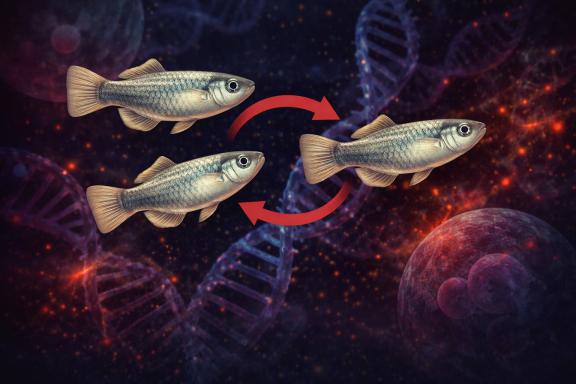
The Amazon molly is an all-female species that should have gone extinct tens of thousands of years ago. A new study published in Nature reveals the genetic trick that has kept it alive.
According to a foundational principle of evolutionary biology, the Amazon molly should not exist.
Every individual in this small, thumb-sized freshwater fish species is female. Every one of them reproduces by making exact genetic copies of itself, passing no new combination of genes to the next generation, receiving nothing new from outside. For more than 100,000 years, roughly 500,000 generations, this has been the entire reproductive strategy of a species.
Theory says this should be a death sentence. A new study published in Nature says theory was missing something important.
The Problem With Cloning Yourself Forever
To understand why the Amazon molly is so puzzling, it helps to understand what sexual reproduction actually does for a species.
When two individuals reproduce sexually, their genetic material shuffles together before being passed to offspring. This mixing creates variation, and variation is the raw material that natural selection works with. Beneficial mutations spread. Harmful ones get weeded out or diluted across the population. The deck of genetic cards gets reshuffled with every generation.
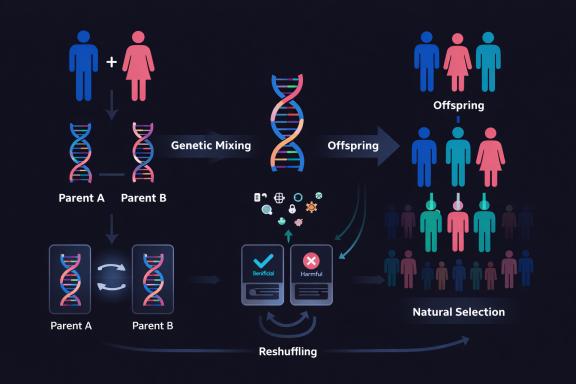
In an asexual species, the deck never shuffles. Every daughter is a copy of the mother, carrying exactly the same mutations, good and bad alike. Over time, harmful mutations accumulate in the genome faster than they can be removed, a process geneticists call Muller’s ratchet, named for geneticist Hermann Muller who described it in 1964. The ratchet only clicks in one direction.
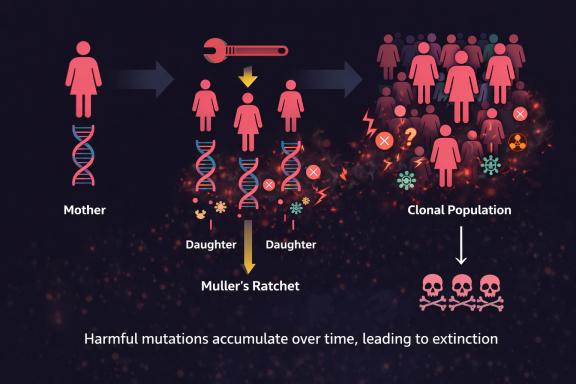
Once a harmful mutation appears and spreads through a clonal population, there is no sexual recombination to remove it. It stays. More mutations accumulate on top of it. Eventually the genome becomes so degraded that the species can no longer function and goes extinct.
Models of how quickly this process unfolds predict that an asexual vertebrate species should succumb within 10,000 to 100,000 generations. The Amazon molly has already survived 500,000.
An Accident That Became a Species
The Amazon molly, known scientifically as Poecilia formosa, came into existence around 100,000 years ago near what is now Tampico on the Gulf coast of Mexico. A female Atlantic molly (Poecilia mexicana) mated with a male sailfin molly (Poecilia latipinna), and the resulting hybrid turned out to be something entirely new: an all-female species capable of reproducing without contributing genetic material from any father.
Every Amazon molly alive today traces its lineage back to that single hybridisation event. The species was discovered in 1932, when it became the first vertebrate animal confirmed capable of asexual reproduction.
The fish is not entirely celibate. To trigger the development of her eggs, a female Amazon molly must mate with a male from one of the two parent species. The male’s sperm initiates embryo development, but his genetic material is not incorporated into the offspring. He is, in evolutionary terms, a biological trigger rather than a genetic contributor.
The Genetic Copy-and-Paste That Changed Everything
The new study, led by computational biologist Edward Ricemeyer at the Ludwig Maximilian University of Munich, used a technique called long-read sequencing to examine the Amazon molly’s genome in unprecedented detail and compare it directly with the genomes of both parent species.
What they found was a process called gene conversion, operating at a scale and in a role no one had documented in an asexual vertebrate before.
Gene conversion is a form of DNA repair. When two similar but not identical stretches of DNA exist alongside each other, one can be copied over the other, overwriting differences between them. In sexually reproducing species, this happens during the genetic shuffling of reproduction. In the Amazon molly, it is happening in the body’s own cells, working on the two different sets of chromosomes the fish inherited from its two parent species 100,000 years ago.
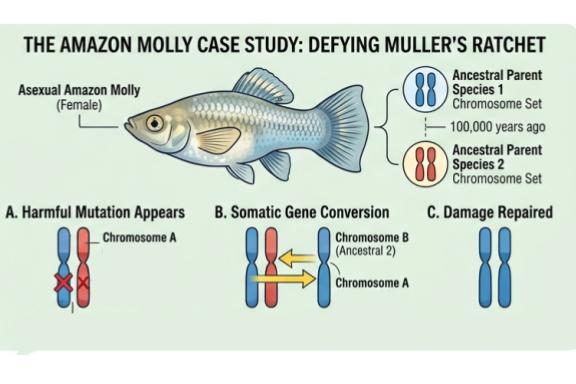
The process works in two directions. When a harmful mutation appears in one part of the genome, gene conversion can overwrite it with an undamaged copy from the corresponding region of the other ancestral chromosome. The damage is repaired without any sexual recombination. Muller’s ratchet clicks, but gene conversion clicks it back.
“It’s pushing back against this accumulation of mutations,” Ricemeyer said, according to reporting from the Columbia Today. The mechanism can also work in the opposite direction, fixing beneficial mutations in place and allowing them to spread through the population.
“We always thought it was an evolutionary dead end, if you’re asexual,” said Annette MacLeod, a parasitologist at the University of Glasgow who was not involved in the study, in comments reported by Science magazine. “But it doesn’t have to be.”
Why This Matters Beyond One Fish
The Amazon molly is not the only asexual vertebrate. Komodo dragons can produce offspring without males. Some shark species have done the same. Several gecko, lizard, and snake species reproduce entirely without sex. What the new study suggests is that gene conversion may be a widespread but previously unrecognised survival mechanism across many of these species, not a quirk unique to one small fish from Mexico.
“What Ricemeyer and his colleagues found in the genomes of Amazon mollies is probably what’s going on in other asexual species,” said Micah Dunthorn, a microbiologist at the University of Oslo, in comments reported by National Geographic. “They just haven’t shown it yet.”
The implications extend beyond evolutionary biology. Cancer, Ricemeyer noted in interviews around the study, is itself a clonal phenomenon: a lineage of cells that accumulates mutations and outgrows everything around it. Understanding how the Amazon molly manages, repairs, and controls its clonal genome without going into genetic meltdown could inform new thinking about how cancer cells accumulate the mutations that make them so dangerous.
“Really forces us to believe outside of the box and outside of the textbooks,” said Anne-Marie Dion-Cote, an evolutionary geneticist quoted in Nature coverage of the paper.
The Amazon molly has been doing exactly that since before our species built its first cities.
Sources
The paper, “Gene conversion empowers natural selection in a clonal fish species,” was published in Nature in March 2026 by Edward S. Ricemeyer and colleagues at the Ludwig Maximilian University of Munich and collaborating institutions. DOI: 10.1038/s41586-026-10180-9.
Quotes attributed to researchers in this article are drawn from reporting by Science magazine, National Geographic, and Columbia Today, published in March 2026, and from a press release issued in connection with the Nature publication.

Jane holds a BSc in Biology from the University of Regina and a Master of Science in Bioscience, Technology and Public Policy from the Univesity of Winnipeg. Her reporting interests include Life Sciences, Physical Sciences and the Cosmos.