
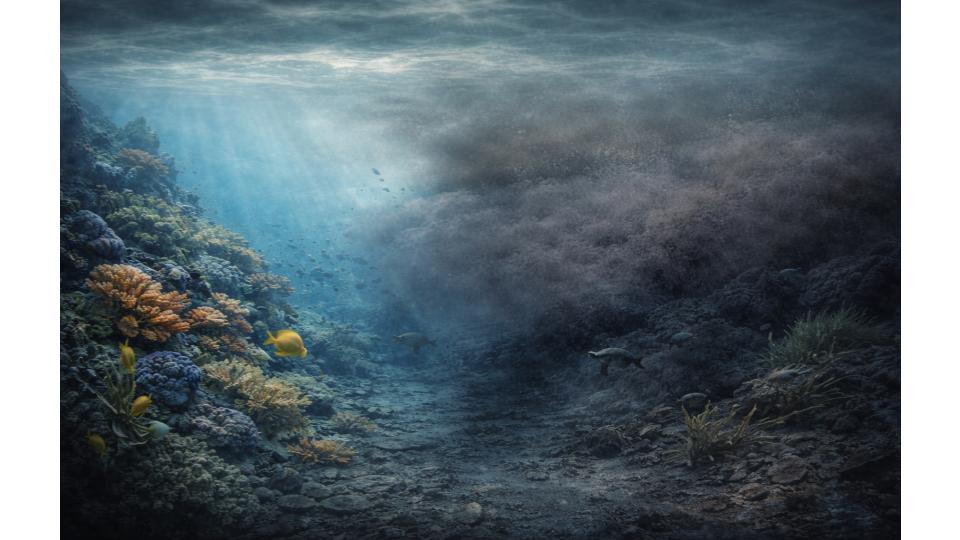
Sudden underwater blackouts called marine darkwaves can plunge the seafloor into near-total darkness for weeks or months at a time. Until now, the phenomenon did not even have a name.
Imagine a reef that one morning wakes up in the dark. Not from a storm cloud overhead, but from the water itself turning opaque, the light fading out as sediment, algae, and debris cloud the column above. The kelp stops growing. The seagrass begins to starve. The fish that rely on vision to hunt change their behaviour, drifting in disoriented patterns through water they can barely see through. This blackout might last a few days. It might last several months.
Scientists have known for years that this happens. Until recently, they had no consistent way to measure it, no shared name for it, and no framework for comparing one event to another across different oceans. A new study published in the journal Communications Earth and Environment changes all of that, introducing the term marine darkwave and offering the first scientific tool for tracking these events globally.
What a Darkwave Actually Is
A marine darkwave is a sudden, intense episode of underwater darkness that drops light levels significantly below what is normal for a given location and depth, and that lasts long enough to cause measurable ecological damage. The definition was deliberately designed to be flexible across different environments, since light conditions vary widely between a shallow tropical reef and a kelp forest off the California coast. What matters is not the absolute amount of darkness but how far conditions have fallen below the expected baseline for that specific place and time of year.
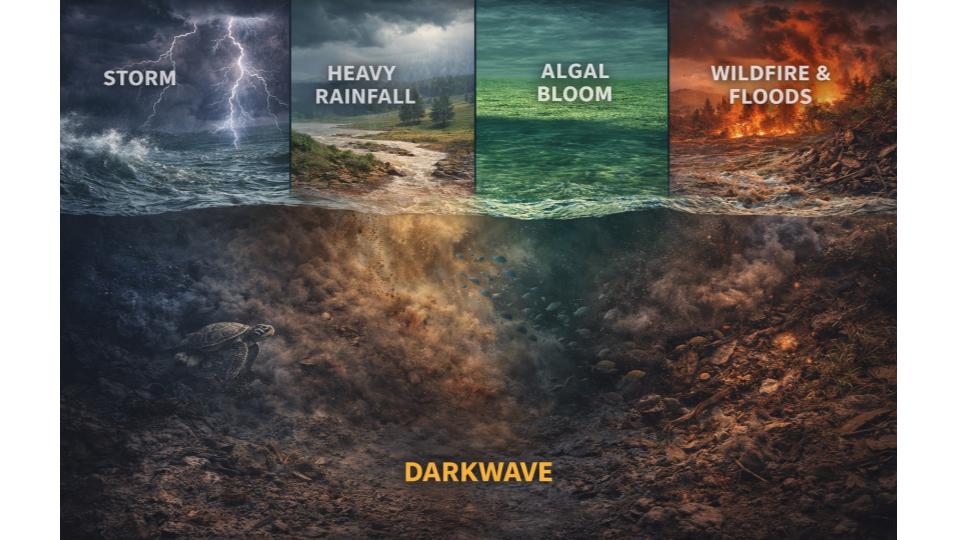
The causes are varied. Storms stir sediment from the seafloor and drive it through the water column. Heavy rainfall washes soil, organic matter, and nutrients from land into coastal waters. Algal blooms, fed by those nutrients, form dense surface layers that block sunlight from penetrating. Wildfires and floods send pulses of debris into the ocean that can persist for weeks. Any of these events, or a combination of them, can trigger a darkwave.
“Light is a fundamental driver of marine productivity all the way up to the upper food chain, yet until now we have not had a consistent way to measure extreme reductions in underwater light, and this phenomenon did not even have a name,” said lead author François Thoral of the University of Waikato and the University of Canterbury in New Zealand, in a statement released by UC Santa Barbara. “Marine darkwaves allow us to identify when and where these events occur, shedding new light on a critical but often overlooked phenomenon.”
What Happens When the Light Goes Out
The ocean’s food web is built on photosynthesis. Kelp, seagrass, and coral all depend on sunlight to grow and generate energy. When light disappears suddenly, even for a few days, the effects ripple upward through the entire ecosystem.
Laboratory experiments cited in the study show that even brief darkness impairs the physiology and productivity of macroalgae and seagrasses. A simulated 35-day darkening event produced measurable decreases in phytoplankton levels and shifts in the overall community composition of the ecosystem tested. In severe cases, prolonged darkness drains the energy reserves of photosynthetic organisms entirely, leading to dieback and mortality across entire patches of reef or kelp forest.
The effects are not limited to plants. Fish, sharks, and marine mammals alter their feeding and movement patterns when visibility drops sharply. Some species use light as a timing cue for migration and reproduction. A marine darkwave can disrupt those biological signals, throwing behaviours out of sync in ways that may persist long after the water clears.
Darkwaves can also affect ocean chemistry. Reduced photosynthesis means less oxygen production. When a darkwave is triggered by sediment runoff carrying high loads of organic matter, the decomposition of that matter consumes oxygen, potentially creating hypoxic zones where little can survive.
A Crisis Hiding Inside a Bigger One
Scientists have tracked a separate, slower phenomenon for years called ocean darkening: a long-term, gradual decline in water clarity driven by rising sediment loads, increasing nutrient runoff, and changing ocean conditions. Since the early 2000s, more than one-fifth of the global ocean has darkened in this slow, sustained way. The concern has been that this steady dimming is quietly starving reefs and kelp forests over decades.
The new research suggests that this long-term picture may be obscuring a more immediate threat. While scientists have focused on the gradual trend, they have largely missed the short, sharp blackouts happening on top of it. A marine darkwave may last only weeks, but its ecological damage can be as severe as years of gradual darkening, and it can strike ecosystems that are already weakened by the longer trend.
“Even short periods of reduced light can impair photosynthesis in kelp forests, seagrass and corals,” Thoral said in a statement. “These events can also influence the behaviour of fish, sharks and marine mammals. When darkness persists, the ecological effects can be significant.”
What the Data Shows
The research team drew on two long-term datasets to test their framework. In California, 16 years of continuous underwater light measurements collected at the Santa Barbara Coastal Long Term Ecological Research site, one of the only programs in the world to track seafloor light over such an extended period, revealed repeated darkwave events, some lasting several weeks.
Satellite data covering 21 years along New Zealand’s East Cape coast revealed a broader pattern still. Up to 80 marine darkwaves occurred in that region between 2002 and the present, most tied to storms and river-driven sediment plumes.
Cyclone Gabrielle, which struck New Zealand in February 2023, provided the starkest example. The storm delivered enormous quantities of sediment into coastal waters, and satellite imagery showed the ocean around Waihau Bay in the Eastern Bay of Plenty turning almost entirely opaque. Some parts of the seabed received essentially no light for several weeks. The ecological impacts in those areas are still being assessed.
A Framework Built for the Future
The significance of the marine darkwave concept extends beyond any single finding. Researchers studying ocean health already use standardised frameworks to track marine heatwaves, ocean acidification, and deoxygenation events. Each of those frameworks gives coastal managers, conservation groups, and policymakers a shared language and a consistent measurement tool for recognising and responding to acute stress in the ocean.
Marine darkwaves now join that toolkit. Co-author Bob Miller, a research biologist at UC Santa Barbara’s Marine Science Institute, explained the value of that standardisation in a statement. “This study creates a framework for comparing such events, which we call darkwaves,” he said.
The next step is expanding the monitoring network. Very few programs worldwide currently collect the continuous, long-term seafloor light measurements needed to track these events in real time. The researchers plan to broaden their work at the Santa Barbara site and are calling for similar monitoring programs in other coastal regions, particularly in areas facing rising storm intensity and increasing land-based runoff.
Sources
The paper, “Marine darkwave as an event-based framework to assess unusual periods of reduced underwater light availability,” was published in Communications Earth and Environment in January 2026 by François Thoral and colleagues at the University of Waikato, the University of Canterbury, UC Santa Barbara, the University of Western Australia, and several other institutions. DOI: 10.1038/s43247-025-03023-4.
Quotes in this article are drawn from press releases issued by UC Santa Barbara and the University of Waikato in January 2026.

Jane holds a BSc in Biology from the University of Regina and a Master of Science in Bioscience, Technology and Public Policy from the Univesity of Winnipeg. Her reporting interests include Life Sciences, Physical Sciences and the Cosmos.