
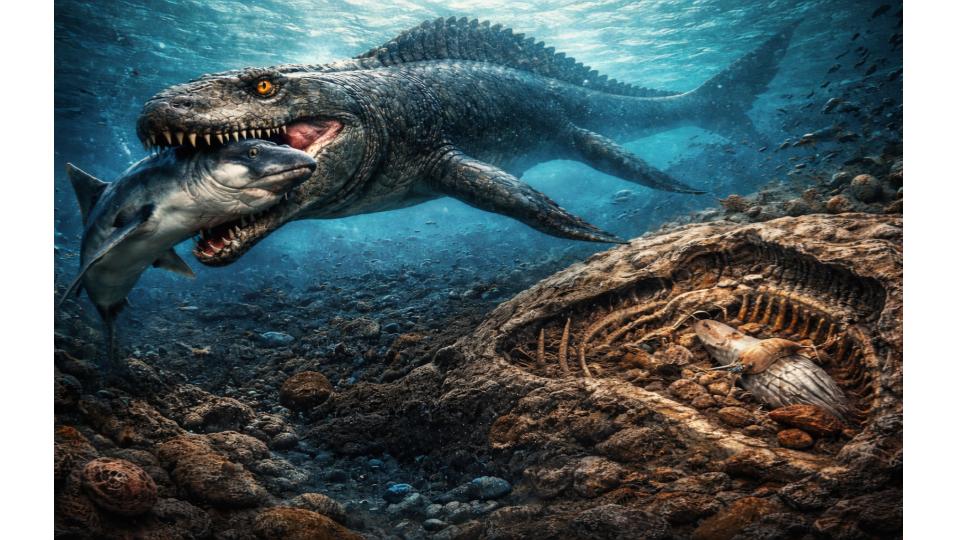
The 155-million-year-old specimen from Germany is one of the best-preserved examples of Dakosaurus maximus ever discovered and provides rare direct evidence of the animal’s diet.
MUNICH — Paleontologists have described a 155-million-year-old marine reptile fossil found with the remains of a large shark preserved inside its abdominal cavity, providing direct evidence that the species hunted sizeable, dangerous prey rather than small fish.
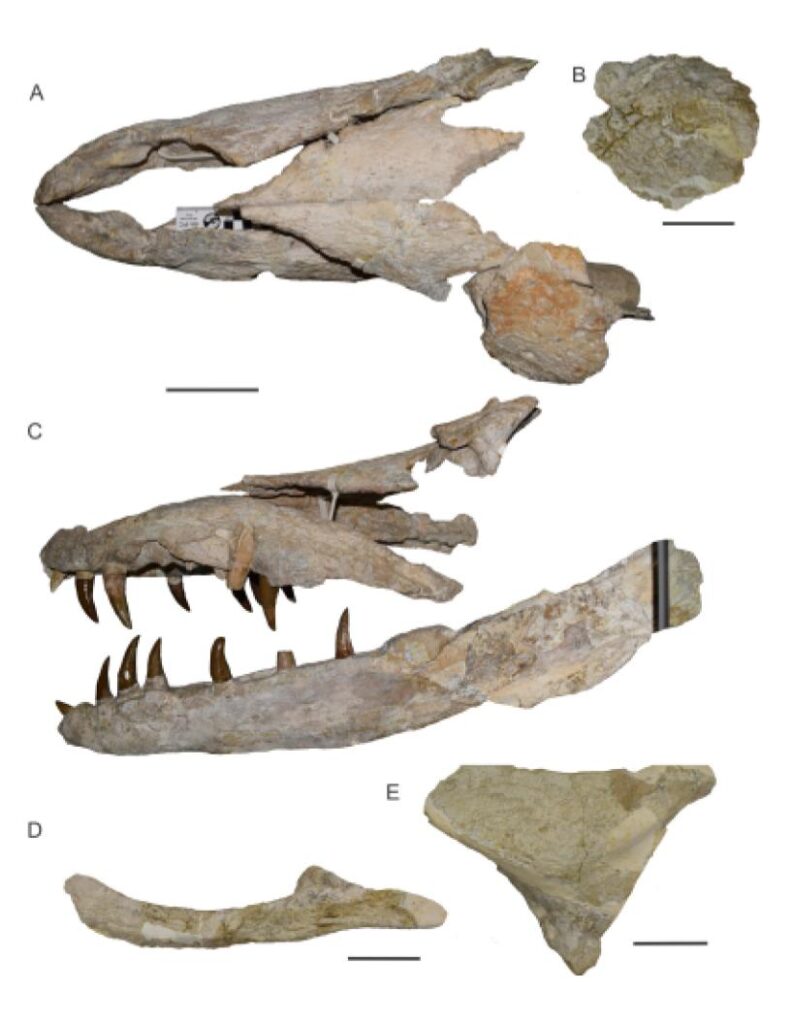
The specimen, a Dakosaurus maximus recovered from Germany’s Torleite Formation, is described in a January 2026 paper in Palaeontologia Electronica by researchers Yanina Herrera, Frederik Spindler, and Mario Bronzati. The skull is largely complete and much of the skeleton remains articulated, making it one of the best-preserved metriorhynchid fossils ever found.
Preserved within the abdominal region were cartilaginous remains of a hybodont shark, a stocky, powerful fish common in Jurassic seas that could exceed two meters in length. Both predator and prey were buried together in seafloor sediment and remained there for 155 million years.
Fossilized stomach contents are extraordinarily rare. Soft tissues decompose quickly after death and stomach contents almost never survive long enough to mineralize. When they do, they provide something anatomy alone cannot, direct evidence of an actual meal rather than behavior inferred from tooth shape or skull structure.
What Dakosaurus maximus was
Dakosaurus maximus belonged to a group called metriorhynchids, prehistoric relatives of crocodiles that evolved into fully marine animals during the Jurassic Period. Over millions of years their legs became flippers, their tails developed shark-like fins for propulsion, their skin became smooth, and they evolved salt glands to survive in saltwater.
Most metriorhynchids had long narrow snouts suited for catching fish. Dakosaurus maximus was different. It had a short, wide, powerful skull more similar to a large theropod dinosaur than a crocodile, with enormous serrated blade-like teeth that paleontologists have compared in function to those of killer whales, designed for tearing into large prey rather than snatching small fish.
The new specimen allows researchers to produce the most comprehensive anatomical study of the species ever published, resolving longstanding debates about skull shape, spinal structure, and how the animal compared to related species.
Significance of the stomach contents
The shark remains confirm what the animal’s anatomy had long suggested, that Dakosaurus maximus was a macrophagous predator that targeted large animals rather than small fish. Hybodont sharks were themselves predators occupying a high position in Jurassic food webs. Finding one inside a Dakosaurus indicates the reptile was capable of successfully hunting other apex-level predators.
The find provides a concrete data point about Jurassic ocean ecology that fossil anatomy cannot supply on its own. Tooth shape and skull structure indicate what an animal was capable of eating. Stomach contents indicate what it actually ate.
An ecological niche with no modern equivalent
Metriorhynchids as a group occupied a position in marine ecology that no living animal fills today. Modern crocodilians inhabit rivers and coastal wetlands but never fully adapted to open ocean life. Contemporary marine reptiles, including sea turtles, sea snakes, and marine iguanas, bear no resemblance to the large marine predators of the Jurassic.
Dakosaurus maximus combined the ancestry of a crocodilian, the body plan of a dolphin, and the hunting strategy of a killer whale, without being closely related to any of them. The entire metriorhynchid lineage disappeared during the Early Cretaceous approximately 120 million years ago, leaving no descendants.
The German specimen is now the most complete record of how the animal was built, how it moved, and what it consumed.
Source
Herrera, Y., Spindler, F., & Bronzati, M. (2026). Dakosaurus maximus: Morphology and Palaeoecology. Palaeontologia Electronica, 29.1.a4. DOI: 10.26879/1577

Ray Jackson holds a BSc in Electrical Engineering from the University of Manitoba and a PhD in Physics from Carleton University. His reporting interests include Current and Future Technologies, Engineering and Artificial Intelligence.