
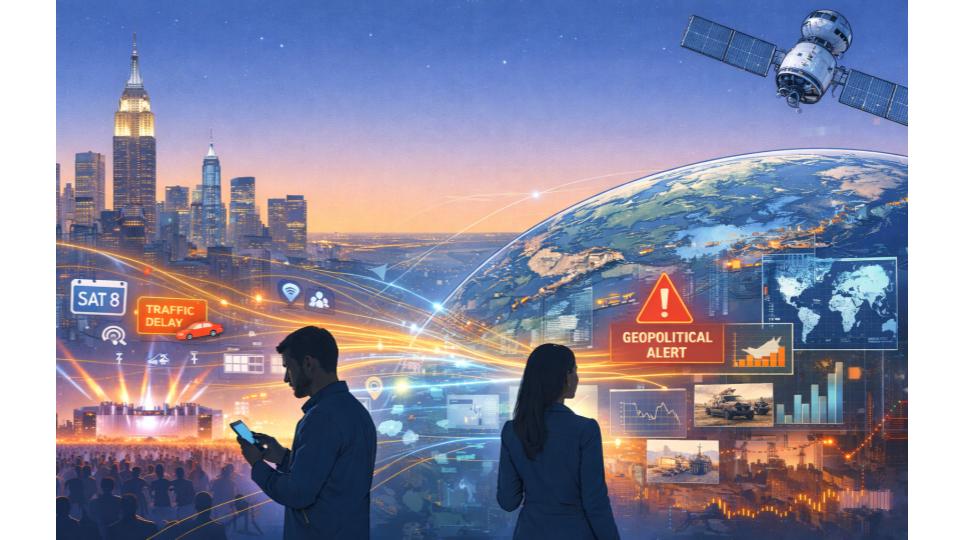
The patent describes a continuous monitoring architecture that detects converging data streams and surfaces relevant information automatically, without a search query.
NEW YORK — A New York-based artificial intelligence company has been granted a patent for a system that monitors location, time, and live data streams to deliver information to users before they search for it, according to a patent granted February 24, 2026 by the U.S. Patent and Trademark Office.
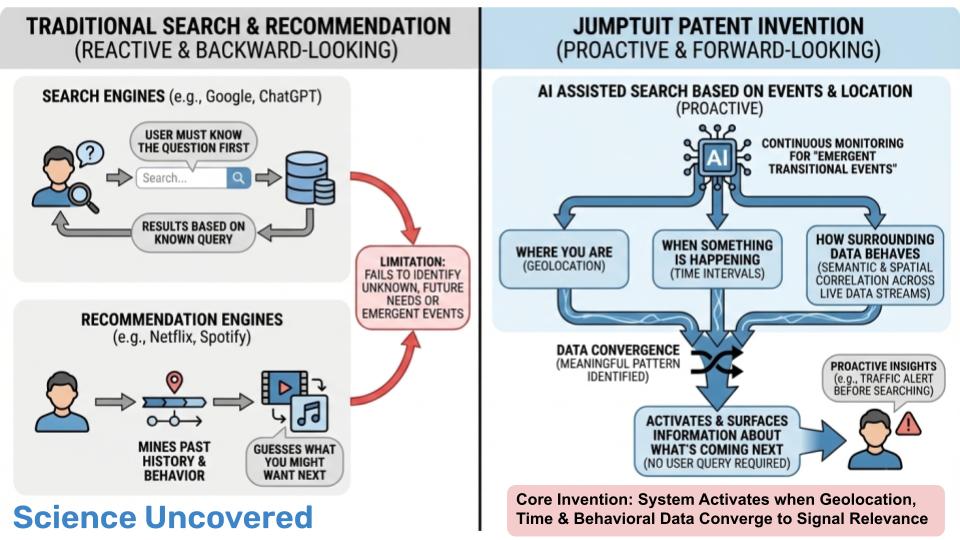
The patent, assigned to Jumptuit and its founder Donald Leka, covers what the filing calls a system and method of AI assisted search based on events and location. Rather than waiting for a user to submit a query, the system continuously monitors data streams tied to a specific place and time, detects when they begin converging in a meaningful pattern, and retrieves relevant information automatically.
Jumptuit describes the approach as anticipatory intelligence. The company has previously focused on geopolitical and market-risk intelligence for Fortune 500 companies and government agencies. Leka said the February patent is part of a broader intellectual property strategy the company plans to expand on.
How the system works
The patent describes a system that aligns three dimensions simultaneously: the user’s geolocation, a time interval tied to an upcoming event, and the semantic and spatial behavior of surrounding live data streams. When those elements converge in a pattern the system identifies as relevant, it activates and surfaces information without a prompt.
The patent offers a consumer example: a user driving toward a concert venue on a Saturday evening. The system detects the event on the user’s calendar, correlates it with real-time crowd density, transit delays, nearby parking availability, and weather forecasts, and surfaces relevant information before the user encounters traffic. No search query is entered at any point.
A second example involves institutional use: an analyst monitoring geopolitical risk. The system detects unusual clustering across supply chain disruptions, satellite imagery, social media signals, and financial flows converging on the same region and time window, and assembles a picture from across those data sources without waiting for a query.
The gap it is designed to fill
Current AI assistants, including general-purpose large language model products, are reactive systems. They generate responses to queries but have no independent awareness of time, location, or unfolding real-world context. They remain idle until prompted.
Conventional recommendation engines address a different limitation. Systems that suggest content based on viewing or purchase history are backward-looking, drawing on past behavior to estimate future preferences. They do not reason about events unfolding in the external environment.
Jumptuit’s patent addresses what it characterizes as a structural gap: search and recommendation systems only help users who already know they need help. Costly failures in enterprise, logistics, emergency response, and government contexts frequently occur because no one knew to look for a problem until it had already developed.
Scope and context
The patent covers the core architecture of event- and location-triggered anticipatory retrieval. Jumptuit has not announced a commercial product timeline or disclosed which specific data sources the system would integrate in deployment.
The company’s existing work in institutional risk intelligence suggests the enterprise and government markets are the primary near-term targets, though the patent’s described use cases include consumer applications such as travel, commuting, and event planning.
Source: System and Method of AI Assisted Search Based on Events and Location, US 12,561,386, USPTO, granted February 24, 2026. Assignee: The Jumptuit Group, New York.

Ray Jackson holds a BSc in Electrical Engineering from the University of Manitoba and a PhD in Physics from Carleton University. His reporting interests include Current and Future Technologies, Engineering and Artificial Intelligence.