
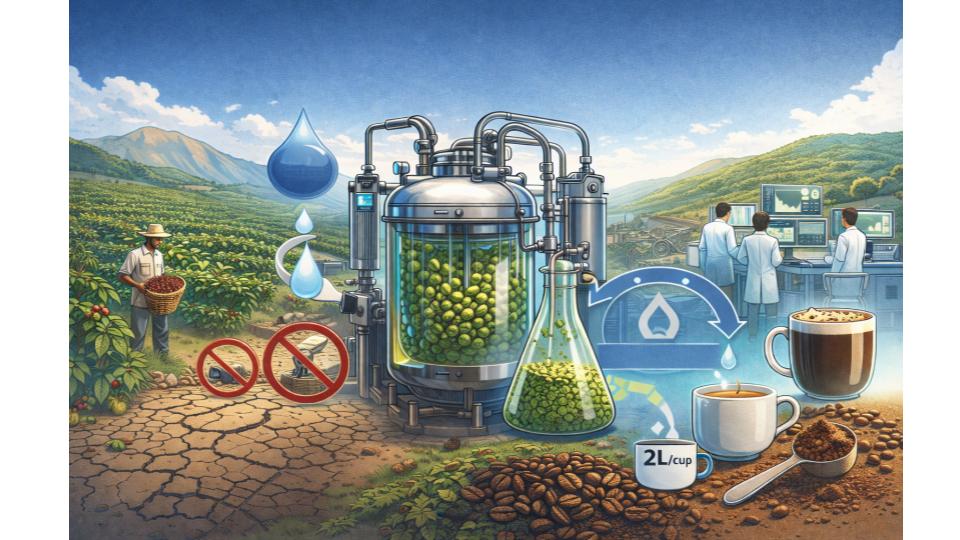
Cellular coffee grown in bioreactors uses 98 percent less water than conventional farming and requires no agricultural land. Regulatory approval and scaling remain the primary hurdles.
HELSINKI — A Finnish research team that demonstrated drinkable lab-grown coffee in 2021 has seen the technology advance toward commercial production, with a biotech company targeting a 2027 to 2028 market launch as climate pressures accelerate demand for alternatives to conventional coffee farming.
In November 2025, Coffeesai, a subsidiary of Israeli biotech company Pluri, announced partnerships in East Asia and Mexico, including a collaboration with the Instituto del Café de Chiapas, aimed at bringing cellular coffee to market within two to three years. The VTT Technical Research Centre of Finland, whose researchers first brewed coffee from cultured plant cells, won the 2024 Journal of Agricultural and Food Chemistry Research Article of the Year Award for the work.
The timing reflects growing pressure on conventional coffee supply. Scientists project that by 2050, climate change will render half of currently suitable coffee-growing land unusable. Global coffee exports fell 14.2 percent in January 2025 compared to the previous year. Arabica prices exceeded four dollars per pound for the first time in recorded history.
“The science is proven,” said Dr. Heiko Rischer, who led the VTT research team. “What comes next is scaling it to meet global demand.”
How cellular coffee is produced
Cellular coffee does not use synthetic flavoring or substitute ingredients. It grows actual coffee plant cells in a controlled environment, without the plant itself.
Researchers take cuttings from coffee plant leaves, sterilize them, and place them on a growth medium containing sugars, vitamins, minerals, and plant hormones. The cells revert to an undifferentiated state and begin dividing, forming a mass called a callus.
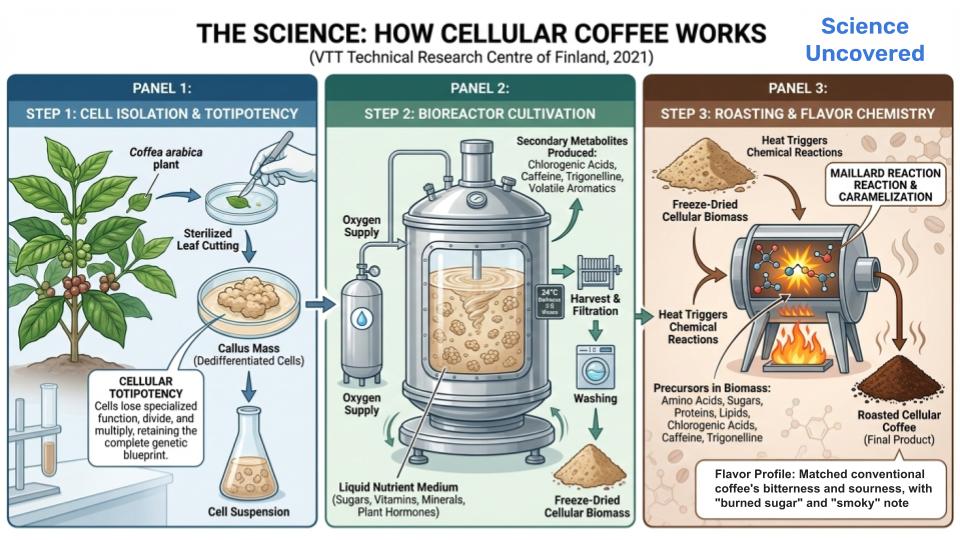
That mass is transferred to steel bioreactors filled with liquid nutrient medium, where the cells consume nutrients and produce the chemical compounds that give coffee its flavor, including chlorogenic acids, caffeine, trigonelline, and volatile aromatic compounds.
After two to three weeks, the biomass is harvested, filtered, washed, and freeze-dried. The dried material is then roasted. Because cellular biomass is lighter and more porous than whole beans, roasting temperatures and times are adjusted accordingly. Gas chromatography analysis of the VTT product showed a flavor profile matching conventional coffee in bitterness and acidity, with distinct roasted sugar and smoky notes.
Coffeesai uses a three-dimensional cell expansion process that allows higher cell densities than flat cell cultures. The company reports producing the equivalent output of 1,000 coffee trees in three weeks.
Resource comparison with conventional farming
Conventional coffee production requires approximately 140 liters of water per cup. Cellular production uses closed, recyclable water systems, reducing water consumption by an estimated 98 percent. Bioreactor production requires no agricultural land, no pesticides, and no deforestation.
The primary resource trade-off is energy. Bioreactors require electricity for temperature control, agitation, and aeration. The net environmental benefit depends on whether that energy is sourced from renewables or fossil fuels.
Bioreactors also allow environmental conditions to be controlled precisely. Nutrient composition can be adjusted to replicate regional soil chemistry. Temperature cycling can simulate day and night variation. Dissolved oxygen levels can replicate high-altitude growing conditions. The process involves no genetic modification. The cells are genetically identical to the parent plant and produce the same compounds.
Regulatory and scaling hurdles
Cellular coffee must clear regulatory approval before it can reach consumers. In the United States, it requires FDA approval as a novel food ingredient. In Europe, it requires Novel Food authorization, a process that typically takes three to five years. The non-GMO status of cellular coffee is considered an advantage in both regulatory processes.
Scaling from experimental batches to industrial output presents additional challenges, including contamination control across large numbers of bioreactors, consistency of flavor profiles at volume, energy efficiency, and large-scale freeze-drying and roasting capacity.
Implications for coffee farming regions
The Mexico partnership with the Instituto del Café de Chiapas points toward a hybrid model in which bioreactor technology complements rather than replaces existing agricultural expertise. Climate change is already disrupting traditional coffee farming in major producing regions. Brazil, which accounts for roughly a third of global coffee production, has experienced recurring droughts and heat waves that have reduced harvests in recent years.
Researchers have also identified potential applications beyond replicating existing products, including recreating flavor profiles from extinct coffee varieties using preserved tissue and producing single-origin flavor profiles independent of geography.
Sources
Aisala, H., Kärkkäinen, E., Jokinen, I., Seppänen-Laakso, T., & Rischer, H. (2024). Proof of Concept for Cell Culture-Based Coffee. Journal of Agricultural and Food Chemistry. DOI: 10.1021/acs.jafc.3c04503
VTT Technical Research Centre of Finland. (2023). Sustainable coffee grown in Finland.
Global Coffee Report. (2025). Is lab-grown coffee the future of the industry?
Pluri Inc. (2025). Leading Global Players Back Pluri’s Cell-Based Food Collaborations.
BioProcess Insider. (2025). Coffeesai and INCAFECH to advance cell-based coffee
Bunn, C., Läderach, P., Rivera, O.O., & Kirschke, D. (2015). A bitter cup: climate change profile of global production of Arabica and Robusta coffee. Climatic Change, 129(1), 89–101.

Ray Jackson holds a BSc in Electrical Engineering from the University of Manitoba and a PhD in Physics from Carleton University. His reporting interests include Current and Future Technologies, Engineering and Artificial Intelligence.